You stand at the extrusion line. The screw turns at a stable RPM, melt flows evenly through the die, and the bubble rises without the dreaded wobble. The air ring cools it symmetrically, frost line holds steady, and the collapsing frame delivers a flat web to the winder. That sequence—trouble‑free, repeatable, shift after shift—is what separates a well‑specified mono‑layer line from one that generates scrap reels.
Single‑screw extrusion remains the workhorse of blown film production because the process itself is remarkably simple: feed granules, melt, push through a circular die, inflate with air, cool, flatten, and wind. No extruder is better suited to high‑volume polyethylene film across a wide spec range. The real question is not whether a film blowing machine can do the job, but which combination of screw geometry, die size, and downstream components matches your daily output targets.
Material flexibility: LDPE, HDPE, LLDPE—what each resin does on the same base machine
Blown film converters rarely run a single material. Order books fluctuate between LDPE for garment bags, HDPE for T‑shirt sacks, and LLDPE for stretch applications. A single‑screw film blowing machine can process all three, but the property differences demand adjustments to the temperature profile and die gap.
LDPE: clarity and flexibility
LDPE (low‑density polyethylene) has good melt strength and produces films with clarity and flexibility—ideal for supermarket flat bags and general packaging. The sticky flow temperatures for polyethylene resins fall between 105‑135°C [1†L9-L11].
HDPE: stiffness and opacity
HDPE (high‑density polyethylene) requires higher extrusion temperatures and produces stiffer, more opaque films with excellent printability for T‑shirt bags. It is the go‑to resin for high‑speed bag‑making lines.
LLDPE: puncture resistance
LLDPE (linear low‑density polyethylene) adds puncture resistance and elongation, frequently used in blends with LDPE for goods that need added strength. It behaves differently in the screw because of its narrower molecular weight distribution.
The Pro series is explicitly built to handle all three, with the screw and barrel constructed from high‑quality alloy steel, given optimal hardness through nitride treatment and precision finishing [9†L17-L19]. That metallurgy matters because LLDPE’s higher viscosity increases internal shear, and a screw that is not adequately hardened will show wear grooves within 18 months.
Width and gauge: what the numbers 100‑500mm and 600‑1200mm actually mean for your order book
Film width range is the first filter in machine selection. The Pro series spans from 100‑500mm on the smaller MONO‑45 platform to 600‑1200mm on the MONO‑65 [9†L23-L25]. That range covers supermarket flat pockets at the narrow end and industrial pallet wrap or agricultural mulch at the wide end.
Thickness by material type
For HD (HDPE/LLDPE), the thickness range runs from 0.009‑0.10mm on the narrower models up to 0.009‑0.15mm on the MONO‑60 and MONO‑65. For LD (LDPE), thickness spans 0.02‑0.15mm on the smaller units and 0.03‑0.15mm on the larger frames [9†L26-L28].
The ability to produce down to 0.009mm film (9 microns) is significant—that is heavy‑gauge shrink wrap territory, not lightweight shipping film. At the low end, 0.02‑0.03mm thickness is typical for produce bags and lightweight garment covers. A film blowing machine that cannot maintain gauge uniformity across the full thickness range will produce bags with weak spots or excess material usage. Variations of even 0.005mm translate directly into percent changes in gram weight per bag.
Extrusion output: 40kg/hr to 100kg/hr—matching the screw to the demand
Output ratings depend on material type and screw diameter. The Pro series comes in five models, each with specific output numbers:
| Model |
Screw Diameter (mm) |
Screw L/D Ratio |
Max Output HD (kg/hr) |
Max Output LD (kg/hr) |
Film Width (mm) |
| MONO‑45 |
φ45 |
32:1 |
40 |
50 |
100‑500 |
| MONO‑50 |
φ50 |
32:1 |
45 |
55 |
300‑600 |
| MONO‑55 |
φ55 |
32:1 |
55 |
65 |
400‑800 |
| MONO‑60 |
φ60 |
32:1 |
60 |
75 |
500‑1000 |
| MONO‑65 |
φ65 |
32:1 |
70 |
100 |
600‑1200 |
The HD (HDPE) outputs run about 30‑40% lower than LD (LDPE) ratings because HDPE has higher density and different flow characteristics. A MONO‑65 pushing 100kg/hr of LDPE for garment bags can fill a shipping container of film in a single week—roughly 56,000kg of annual capacity per two‑shift operation.
The film blowing machine designated for 100kg/hr output uses a φ65 screw with a 32:1 length‑to‑diameter ratio. The screw's L/D directly impacts the melting efficiency and homogenization of the melt. A 32:1 ratio provides sufficient transition length and mixing sections for consistent output even with variable resin feed [9†L29-L31].
Screw design and transmission: what a 32:1 L/D and German‑standard drive actually deliver
Why 32:1 instead of 24:1?
Longer L/D ratios produce more uniformly melted resin because the material spends more time under controlled shear and mixing. A 5‑zone heating barrel, typical of a 32:1 design, allows finer segmentation of the temperature profile from feed to metering zones. Shorter screws (24:1) are cheaper to produce but tend to deliver melt with unmelted particles or viscosity gradients that create gauge bands in the blown film [11†L37-L39].
The Pro series achieves a 32:1 L/D across its entire model range—from φ45 up to φ65 [9†L30-L31]. That consistency is rare; many manufacturers shrink the L/D on smaller models to cut costs. A MONO‑45 with 32:1 will process HDPE for narrow grocery bags almost as well as a MONO‑65 for pallet wrap.
German‑standard precision transmission
Extrusion lines are only as reliable as their gearbox. The Pro series product page lists “precision transmission system” built to German standards [0†L6-L7]. In practice, that means helical gearing with high surface hardness, oversized bearings rated for continuous operation, and an oil‑cooled lubrication system that prevents thermal breakdown under sustained near‑maximum load. Transmission failures are among the costliest downtime events; a properly designed gearbox operates >30,000 hours before requiring major service.
Auxiliary systems: from double stabilizing rings to torque motor winding
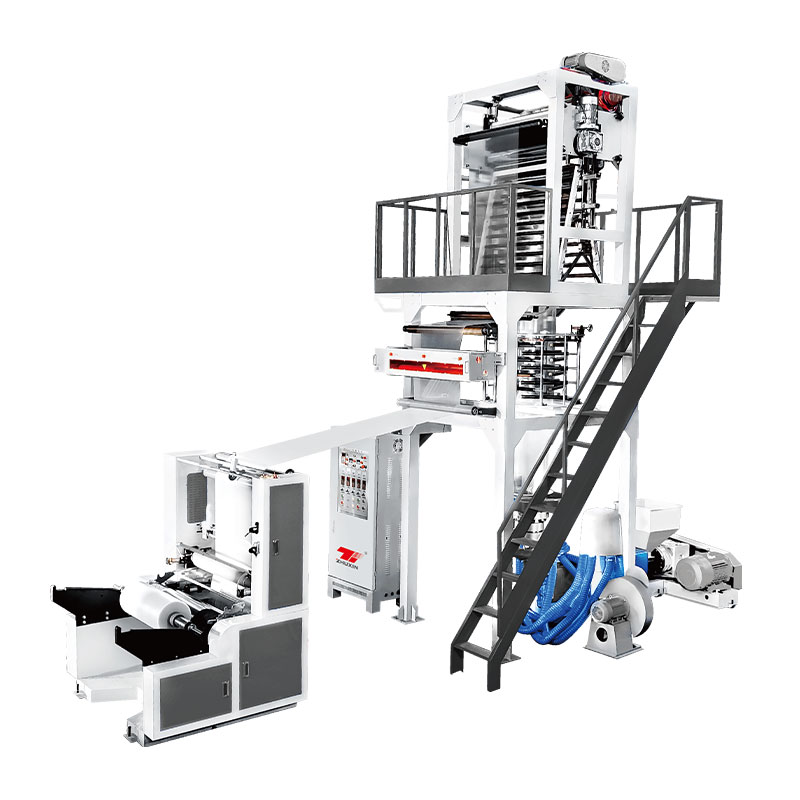
Double stabilizing ring and double‑rolling unit
The bubble column is the most vulnerable section of a blown film line. Ambient air currents, thermal asymmetry, or mechanical vibration can introduce bubble oscillation that telegraphs directly into gauge variation. The Pro series uses a double stabilizing ring—two superimposed annular supports that guide the bubble while allowing unrestricted vertical travel. This geometry dampens oscillation without creating frictional drag marks on the film [9†L20-L22].
The double‑rolling and double‑cutting unit processes the flattened bubble into two separate rolls simultaneously [9†L21-L22]. For bag‑making lines, this design pairs natively with inline printing and bag‑forming stations.
Torque motor winding
Film winding quality determines whether rolls stand up to shipping or telescope on the pallet. The Pro series uses a torque motor winding system that maintains constant film tension by automatically adjusting torque as roll diameter increases [9†L22-L23]. Torque winding is superior to simple surface winding for thin films (0.009‑0.04mm) because it prevents the over‑stretching that causes roll deformation [14†L9-L12].
Temperature control: where PE resin behavior and PID loops meet
Zone profiling from feed throat to die
A blown film line requires a carefully profiled temperature gradient from rear to front, and from barrel to die. For PE resins, the feed section starts around 50‑90°C, rises through transition zones, and the metering section ends near the melt flow temperature of 105‑135°C [1†L39-L41]. The die and adaptor zones are set roughly 10‑20°C lower than the front barrel zones to build melt strength [12†L26-L29].
If the die is too hot, melt strength collapses, and the bubble falls. If it is too cold, melt fracture appears as surface sharkskin, and extrusion pressure spikes. The Pro series PID temperature controllers with multi‑zone regulation are required to maintain those tight bands.
Cooling air ring and frost line positioning
Film properties are set at the frost line—the point where the molten polymer crystallizes. The air ring design influences this line height. An asymmetric cooling airflow creates a low frost line on one side and a high one on the opposite side, leading to gauge bands that repeat every rotation of the bubble. The Pro series auxiliary includes a mounted platform work table for easy operator access to dial in air ring symmetry during startup [9†L20-L21].
Five pre‑shipment tests every buyer should run
Before accepting delivery of any film blowing machine, run these five checks:
-
Uniformity of bubble cooling – Bubble the film and run for 15 minutes. If the bubble wobbles more than 10mm in any direction, the air ring is misaligned.
-
Extruder starting torque – Measure time from power‑on to steady melt flow. More than 35 minutes suggests under‑powered heating bands.
-
Gauge variation across the web – Take a transverse sample and measure thickness every 50mm. Variation should not exceed ±4% of nominal gauge.
-
Winding tension consistency – Monitor torque motor as roll builds. Any telescoping indicates mismatched tension control.
-
Power draw at full load – Compare amperage to nameplate rating. Consistently at 100% indicates screw/barrel mismatch.
How the Pro series fits into Zhuxin's extrusion portfolio
The Pro series is the baseline mono‑layer offering from Zhuxin Machinery, a manufacturer with a history in blown film technology since 1989 and over 2,000 successful installations worldwide [0†L6-L8]. The company builds eight distinct blown film configurations beyond the Pro series, including 3‑layer co‑extrusion and inline gravure printing lines.
Zhuxin maintains a full‑process quality control system and offers on‑site installation and operator training. Field support includes remote diagnostics for the PLC and drive systems, free parts availability checks before shipment, and local agent networks in more than 40 countries.
Matching the machine to your actual weekly output
A MONO‑45 rated for 40kg/hr of HDPE will produce roughly 6,000kg of film per week running two full shifts. A MONO‑65 pushing 100kg/hr of LDPE produces 15,000kg per week. Over‑specifying is as costly as under‑specifying. The right film blowing machine matches your highest sustained demand, plus a 20% buffer.
For more than three decades, Zhuxin Machinery has supplied blown film extrusion equipment to packaging producers across Asia, the Middle East, Africa, and South America. Their Single Screw Film Blowing Machine Pro series delivers consistent gauge control across 0.009‑0.15mm thickness, handles LDPE, HDPE and LLDPE, and achieves 70‑100kg/hr maximum output from a 32:1 L/D screw and German‑standard precision transmission.
【Request a quote from Zhuxin Machinery】

 English
 Español
 Pусский