If you've ever wondered how the plastic films that wrap your groceries, protect your electronics, or line your food containers are made, you're looking at the result of one of the most important manufacturing processes in the packaging industry: co-extrusion blown film production. This technology enables manufacturers to create multi-layer films with precisely engineered properties — barrier strength, flexibility, sealability, and sustainability — all in a single production pass.
At Zhuxin Machinery, we have been specializing in blown film machine and plastic packaging solutions for 36 years. With 6,000+ customers worldwide, self-developed 95% of core components, and 3,200 sets of process parameters accumulated since 1989 covering 200+ material formulations (including PLA/PBAT/PPC), our 5 Layers Film Blowing Machine, AB Film Blowing Machine, ABC Film Blowing Machine, and ABA Film Blowing Machine serve diverse applications from food packaging to agriculture. In this guide, we'll walk you through exactly how co-extrusion blown film works and why multi-layer film production has become essential for modern packaging needs.
1. What Is Co-Extrusion Blown Film?
Co-extrusion blown film is a manufacturing process that combines two or more different polymer materials into a single, multi-layer film structure through simultaneous extrusion. Unlike traditional single-layer film production, which uses one type of resin, co-extrusion allows each layer to perform a specific function.
The process works as follows: molten plastic is extruded through a circular die to form a thin tube, which is then inflated with air to create a bubble. This bubble is cooled, collapsed, and wound into rolls of flat film. The "co-extrusion" aspect means multiple extruders feed different materials into the same die, where they merge into distinct layers before exiting as a unified film tube.
Why Multi-Layer Film Production Matters
Single-layer films have limitations. A monolayer LDPE film offers clarity and flexibility but poor oxygen barrier and limited mechanical strength. By contrast, multi-layer film production can combine:
-
An inner sealing layer for strong heat seals
-
A core barrier layer to block oxygen and moisture
-
Outer structural layers for puncture resistance and printability
This is why co-extrusion blown film has become the dominant technology across food packaging, agricultural applications, and industrial packaging.
2. The Co-Extrusion Blown Film Process: Step-by-Step
Step 1: Material Feeding
The process begins with raw polymer pellets — typically polyethylene (PE), polypropylene (PP), or specialty resins like EVOH, PA (nylon), PLA, or PBAT. Each material is fed into its dedicated extruder through a precision-controlled hopper.
Many barrier materials (especially PA and EVOH) are hygroscopic and absorb moisture from the air. If not properly dried, this moisture will vaporize in the heated barrel, creating bubbles and defects in the final film.
Step 2: Melting and Plasticization in Multiple Extruders
Each extruder is a long, heated barrel with a rotating screw inside. As the screw turns, it pushes the polymer pellets forward while heating zones along the barrel gradually melt the material:
-
Feed zone (rear): Pellets are conveyed and pre-heated
-
Compression zone (middle): Material is melted and homogenized
-
Metering zone (front): Molten polymer is pressurized and stabilized
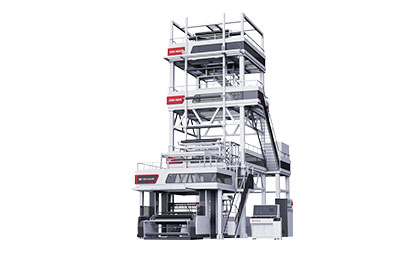
The number of extruders corresponds to the number of layers. A 3-layer ABA film blowing machine uses two extruders (one for the outer A layers, one for the inner B layer), while a 5 Layers Film Blowing Machine requires five extruders.
Step 3: Co-Extrusion Through the Die
Molten polymer from each extruder flows through separate channels in a co-extrusion die and converges at the die lip just before exiting.
The die must accomplish two critical tasks:
-
Layer distribution: Ensure each material forms a uniform, concentric ring
-
Interface bonding: Create strong adhesion between different materials without mixing them
The die design varies by machine configuration:
-
AB Film Blowing Machine: Dual-layer structure balancing inner sealing reliability and outer durability
-
ABA Film Blowing Machine: Symmetrical triple-layer structure enhancing core barrier/strength while reducing material costs and simplifying recycling
-
ABC Film Blowing Machine: Customizable 3-layer design with dedicated barrier, load-bearing, and sealing layers
-
5 Layers Film Blowing Machine: Integrates multiple materials for superior barrier properties, mechanical strength, and temperature resistance
Step 4: Bubble Formation and Air Inflation
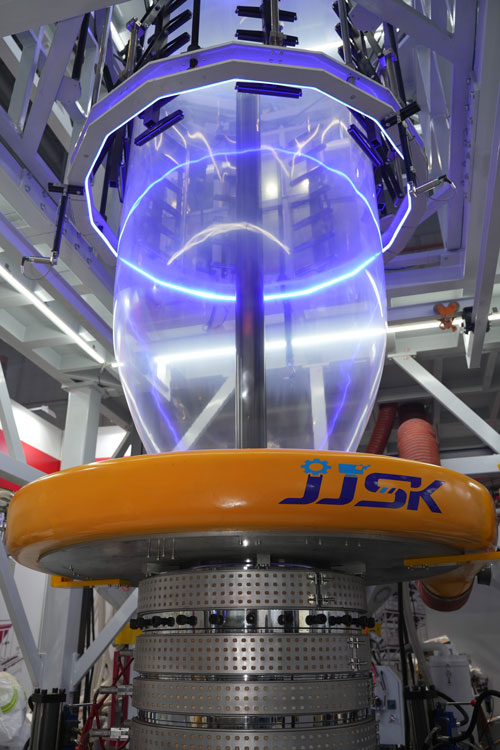
As the multi-layer molten tube exits the die, it enters the air ring — a circular cooling device that blows chilled air onto the exterior. Simultaneously, compressed air is injected into the center of the tube, inflating it into a large bubble.
The ratio of the bubble's final diameter to the die diameter is called the blow-up ratio (BUR). Typical BUR ranges from 2:1 to 4:1:
-
Higher BUR (3:1–4:1): Increases transverse direction orientation, improving tensile strength and barrier properties
-
Lower BUR (1.5:1–2:1): Produces thicker, more rigid films
Step 5: Cooling and Bubble Stabilization
Above the frost line (where the film transitions from molten to solid), the solidified film bubble continues to rise through a collapsing frame. Modern lines use monitoring systems to measure film thickness in real time.
Step 6: Collapsing, Slitting, and Winding
At the top of the tower, the cylindrical bubble is flattened between nip rolls, forming a "layflat" tube. The film may then be:
-
Wound as layflat tubing for bag-making applications
-
Slit open into single or double sheets for wrapping or printing
-
Corona treated to improve surface energy for printing
3. Understanding Zhuxin's Multi-Layer Film Structures
AB Film Blowing Machine
Structure: Dual-layer
Function: Balances inner sealing reliability and outer durability (anti-puncture/tear), delivering cost-effectiveness for industrial and daily-use packaging.
ABA Film Blowing Machine
Structure: Symmetrical triple-layer (A-B-A)
Function: Enhances core barrier/strength while reducing material costs and simplifying recycling, perfect for eco-friendly films.
ABC Film Blowing Machine
Structure: Asymmetrical 3-layer
Function: Customizable design with dedicated barrier, load-bearing, and sealing layers, optimized for high-performance industrial films and specialty applications.
5 Layers Film Blowing Machine
Structure: 5-layer co-extrusion
Function: Integrates multiple materials for superior barrier properties, mechanical strength, and temperature resistance, ideal for premium food/pharmaceutical packaging.
4. Key Process Parameters
Mastering co-extrusion blown film requires precise control of interdependent variables:
4.1 Melt Temperature Profile
Each polymer has an optimal processing temperature range. Deviations cause:
-
Too low: Incomplete melting, poor layer adhesion, unmelted particles
-
Too high: Polymer degradation, discoloration, reduced mechanical strength
4.2 Layer Ratio and Thickness Distribution
The relative thickness of each layer is controlled by adjusting the output rate of each extruder. Typical ratios include:
-
ABA: 20:60:20 (thin outer layers, thick core)
-
5-layer barrier: 15:10:40:10:15 (thick barrier core with thin tie layers)
4.3 Cooling Rate and Frost Line Height
Faster cooling produces smaller crystals, resulting in higher clarity and lower haze. Slower cooling allows larger crystal formation, increasing stiffness and barrier properties.
4.4 Take-Up Speed and Draw Ratio
The speed at which the film is pulled upward determines the machine-direction orientation. Combined with the blow-up ratio, this controls the balance of properties in the final film.
5. Common Challenges in Co-Extrusion Blown Film Production
Challenge 1: Interlayer Adhesion Failure
Cause: Incompatible materials (e.g., PE and PA) lack chemical affinity, leading to delamination.
Solution: Optimized die design that promotes molecular entanglement at layer interfaces, plus tie-layer material recommendations.
Challenge 2: Thickness Variation
Cause: Uneven die flow, temperature gradients, or material inconsistencies.
Solution: Automatic gauge control systems that measure thickness and adjust die bolt temperatures and extruder output.
Challenge 3: Bubble Instability
Cause: Air pressure fluctuations or uneven cooling.
Solution: Dual-lip air rings with independent zone control and bubble diameter sensors.
Challenge 4: Processing Sustainable Materials
Cause: Biodegradable resins (PLA, PBAT) and recycled materials have narrower processing windows.
Solution: Extended L/D ratio extruders for gentle melting, vacuum venting for moisture removal, and specialized screw designs.
Zhuxin's machines are compatible with PLA/PBAT raw materials, with certified compostable films meeting global eco-standards (EN13432, ASTM D6400).
6. Zhuxin's Technological Advantages in Co-Extrusion
Based on our 36 years of technical process precipitation, Zhuxin offers:
35% Energy Saving
Our co-extrusion blown film machines are engineered for 35% energy saving compared to conventional designs, reducing operational costs for multi-layer film production.
170,000+ Hours of Efficient Operation
Zhuxin equipment is designed for long-term reliability, with over 170,000 hours of efficient operation demonstrated in the field.
Long Service Life
1,000+ 1990s-era machines worldwide are still operating efficiently, with an average service life of 22 years.
Pelletizing Recycling System
Our pelletizing recycling system achieves 99.2% material reuse rate, 15% higher than the industry standard.
Self-Developed Core Components
95% of core components are self-developed, ensuring quality control and supply chain reliability.
3,200 Sets of Process Parameters
Accumulated since 1989, covering 200+ material formulations including PLA/PBAT/PPC.
7. Applications of Co-Extrusion Blown Film
Zhuxin's co-extrusion blown film machines support diverse end-use applications:
| Application |
Key Requirements |
Zhuxin Solution |
| Shrink Film |
Uniform heat shrinkage, puncture resistance |
Precision-engineered shrink film with tight, wrinkle-free wrapping |
| Agriculture |
UV stabilization, anti-drip, durability |
Multi-layer UV stabilization and anti-drip technology |
| Express Bags |
Tear resistance, puncture resistance, printability |
High-toughness extrusion with smooth surface for printing |
| Liquid Packaging Bags |
Oil/water/chemical resistance, leak-proof sealing |
Specialized barrier layers compatible with FFS lines |
| Industrial Packing Bag |
Puncture resistance, airtight sealing, load-bearing |
Seamless FFS integration for heavy-duty applications |
| Shopping Bags |
Lightweight, durable, printable, recyclable |
High-precision extrusion with excellent printability |
| Garbage Bags |
Tensile strength, puncture resistance, UV stability |
Heavy-duty co-extrusion with UV-stabilized variants |
| Biodegradable Film & Bags |
Compostable, structural strength, flexibility |
PLA/PBAT compatible, meeting EN13432 and ASTM D6400 |
8. Choosing the Right Co-Extrusion Blown Film Machine
Selecting equipment for multi-layer film production requires matching machine capabilities to your specific needs:
| Factor |
Consideration |
Zhuxin Range |
| Layer count |
How many distinct material functions do you need? |
AB, ABA, ABC, 5-layer configurations |
| Film width |
What is your target layflat width? |
Multiple width options available |
| Output capacity |
What is your volume target? |
Configurable to production needs |
| Material range |
Do you need recycled or bio-based materials? |
Compatible with PCR, PLA, and PBAT |
| Application |
What end-use are you targeting? |
Shrink film, agriculture, packaging, biodegradable |
Conclusion
Co-extrusion blown film has become the standard for modern flexible packaging. By combining multiple materials into precisely engineered multi-layer structures, manufacturers achieve performance characteristics impossible with single-layer films — while reducing material costs and meeting sustainability requirements.
At Zhuxin Machinery, our 37 years of sustainable development in blown film machine manufacturing is built on self-developed 95% of core components, 3,200 sets of process parameters, and a commitment to 35% energy saving and long service life. Whether you need a 5 Layers Film Blowing Machine for premium barrier packaging, an ABA Film Blowing Machine for eco-friendly films, or an ABC Film Blowing Machine for industrial applications, our engineering team can recommend the optimal configuration for your production goals.
Ready to explore co-extrusion blown film production for your facility? Contact our team to discuss your material requirements, production targets, and application needs.
About Zhuxin Machinery
Zhejiang Zhuxin Machinery Co., Ltd. has been specializing in blown film machine and plastic packaging solutions for 37 years. With 6,000+ customers, 95% self-developed core components, and 3,200 sets of process parameters accumulated since 1989, Zhuxin delivers end-to-end plastic packaging solutions including film blowing machines, bag making machines, flexographic printing machines, and paper bag machinery.

 English
 Español
 Pусский