You've seen it happen. The ABC line is running fine—three layers, good output, film looks clean. Then the bubble starts acting up. One minute it's swaying side to side like it's trying to escape the air ring. The next minute it's breathing—diameter expanding and contracting in a steady rhythm. By the time you catch it, you've already lost a full roll to gauge bands and wrinkles.
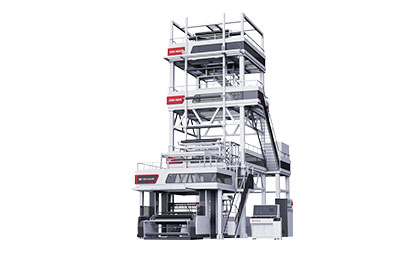
ABC coextrusion is different from monolayer or ABA. Three different resins—often with very different melt flow indices and rheologies—are combined in a single bubble. The interface between layers can become unstable when process conditions aren't perfectly matched. The good news: most instability issues can be resolved without swapping hardware or calling a service engineer. This guide walks through the five most common causes—from melt temperature mismatch to mechanical runout—and gives you a symptom-to-cause reference that gets you back to stable production fast. Zhuxin Machinery's ABC series is engineered with a three-channel co-extrusion structure that supports functional laminates like heat-sealable layers, barrier layers, and abrasion-resistant layers. But even the best ABC film blowing machine needs correct tuning to keep the bubble stable.
Start with the melt temperature
This is the most common cause of instability on ABC lines—and the one that operators often overlook.
Why coextrusion cares about temperature
Each resin has an optimal melt temperature range. LLDPE runs well at 190–210°C; nylon (PA) may need 230–250°C; EVOH sits somewhere in between. When the A layer and the C layer have melt temperatures that differ by more than 15°C, the interface between them becomes disturbed. The hotter layer flows more easily; the cooler layer resists. The result is an interfacial instability that shows up as bubble wobble or thickness variation.
Measure melt temp — not barrel temp
Most extruders show barrel temperatures, not actual melt temperature. Use an infrared pyrometer or a melt temperature probe at the adapter block to measure each layer's melt temperature as it enters the die. This is the temperature that matters—not the barrel setpoint.
The 10°C rule — keep it tight
For stable ABC coextrusion, keep the melt temperature difference between any two layers within 10°C. If A is at 200°C and C is at 220°C, you're in the danger zone. Adjust the hotter layer down or the cooler layer up in 5°C increments until the difference is ≤10°C. Monitor bubble stability for 10 minutes after each adjustment before making the next change.
Check air pressure first
The air ring provides the cooling air that shapes and stabilizes the bubble. Any fluctuation in air pressure—even a few percent—shows up immediately as bubble movement.
A 5% change is all it takes
A pressure fluctuation of just ±5% is enough to make the bubble sway. If your air compressor cycles on and off, the pressure at the air ring can vary by 10–15% between cycles. The bubble responds by drifting left and right in rhythm with the compressor.
Feel it with your hand
Place your hand near the air ring discharge slots while the line is running. Can you feel intermittent changes in air velocity? Does the airflow seem to pulse? If yes, you have a pressure fluctuation problem.
Add a surge tank or VFD
Install a surge tank or pressure regulator between the compressor and the air ring. A properly sized surge tank smooths out pressure variations from compressor cycling. For a more permanent solution, replace the on/off compressor with a variable frequency drive (VFD) compressor that maintains constant pressure. A quick field check: if the bubble sways in a steady rhythm that matches your compressor's cycle time, the air supply is the culprit.
Viscosity mismatch — how to spot it
This cause is unique to coextrusion. When a low-viscosity layer encapsulates a high-viscosity layer, the flow becomes unstable.
When one layer wraps another
In multilayer coextrusion, the layer with lower viscosity tends to wrap around the layer with higher viscosity—a phenomenon called viscous encapsulation. When this happens, the flow distribution around the die circumference becomes uneven. The bubble develops a spiral wobble—a twisting motion that's different from simple swaying or breathing.
The bubble twists, not sways
A spiral wobble looks like the bubble is twisting as it rises. The frost line may appear tilted or uneven around the circumference. This pattern is distinct from the side-to-side sway of an air ring problem.
Adjust speed or temperature
Adjust the outer layer extruder speed or temperature to change its viscosity relative to the core layer. Increasing the outer layer temperature lowers its viscosity; decreasing it raises viscosity. The goal is to minimize the viscosity difference between adjacent layers. If adjusting temperature doesn't work, consider adding a viscosity modifier to the problematic layer. Do not increase overall extruder output to mask the problem—this often makes the instability worse by increasing the flow velocity through the die.
Temperature of the cooling air
The temperature of the cooling air from the air ring directly affects the frost line position and bubble stability.
Let the frost line guide you
When cooling air is too warm, the frost line moves down (closer to the die). The film stays molten longer and becomes soft and floppy, leading to bubble collapse. When cooling air is too cold, the frost line moves up. The film crystallizes too quickly, becoming brittle and prone to tearing or wrinkling.
Ambient plus 5–15°C
For most polyethylene-based ABC coextrusions, the optimal cooling air temperature is ambient temperature plus 5–15°C. If your plant runs at 25°C, aim for 30–40°C air at the air ring discharge. This range provides enough cooling to freeze the film without shocking it.
Change in 2–3°C steps
If you have an air chiller or heater on the air ring supply, adjust the temperature in 2–3°C increments. Monitor the frost line position: it should be stable and horizontal, not oscillating up and down. If the frost line oscillates, the cooling air temperature or flow rate is fluctuating.
Die runout — when 0.2mm matters
The rotating die head is a key feature of advanced ABC lines—it improves film optical properties by averaging out gauge variations. But if the die develops mechanical runout, it becomes a source of instability instead of a solution.
Uneven velocity = uneven bubble
When the rotating die is eccentric—even by 0.1mm—the melt exits the die at uneven velocities around the circumference. One side of the bubble stretches more than the other, creating a tilted or asymmetrical bubble. The film thickness varies circumferentially, and the bubble drifts toward the side with lower melt velocity.
A dial indicator tells the truth
Use a dial indicator to measure the runout at the die face. Mount the indicator on a fixed reference point and rotate the die through 360°. The total indicated runout (TIR) should not exceed 0.2mm. If it does, the die bearings or drive mechanism need attention.
Call when it's over 0.2mm
Runout exceeding 0.2mm usually requires disassembly and repair of the rotating die assembly. This is not a field adjustment—it's a job for a qualified technician. If you're running Zhuxin's patented rotary die head, contact their service team with the measured runout value.
Match the symptom, find the fix
When the bubble is unstable, match the symptom to the most likely cause. This table gets you to the right fix faster.
| Symptom |
Most Likely Cause |
First Check |
| Bubble sways side to side in a steady rhythm |
Air ring pressure fluctuation |
Check compressor cycling; feel airflow at air ring |
| Bubble twists or spirals as it rises |
Uneven layer viscosity (encapsulation) |
Check melt temperature difference between layers |
| Frost line moves up and down (oscillates) |
Cooling air temperature fluctuating |
Check air chiller/heater control |
| Bubble drifts consistently to one side |
Mechanical runout of rotating die |
Measure die face runout with dial indicator |
| Bubble collapses intermittently |
Melt temperature too high (low melt strength) |
Reduce melt temperature 5–10°C |
| Bubble is stiff and tears easily |
Cooling air too cold (film crystallizes too fast) |
Increase cooling air temperature 3–5°C |
Three questions about bubble stability
Q: 7‑layer die for ABC? Not really
A: Technically, no. A 7-layer die is designed for seven distinct layers, not for ABC three-layer configuration. Running it in ABC mode means only three of the seven channels are used, leaving the others idle. This creates flow stagnation and degradation in the unused channels, which can cause gels and contamination. If you need ABC output, use a die designed for ABC—not a multi-layer die running at partial capacity.
Q: New resin batch? Check the MFI
A: If instability started immediately after switching to a new resin batch, the material is the variable. Check the resin's melt flow index (MFI) and compare it to the previous batch. A change of more than 10% in MFI can affect melt strength and bubble stability. Also check the moisture content—wet resin creates bubbles in the melt that disrupt flow. Run a small test batch with the previous material if you still have some. If the instability disappears, you've confirmed the material change as the cause.
Q: Give it 5–10 minutes to settle
A: Allow 5–10 minutes after each adjustment for the process to stabilize. The bubble needs time to reach a new steady state. During this period, avoid making additional changes—you'll end up chasing your own adjustments. After the stabilization period, check film gauge and bubble shape. If the instability persists, make the next adjustment. Rushing the process leads to over-correction and wasted material.
How Zhuxin's ABC series supports stable high‑output production
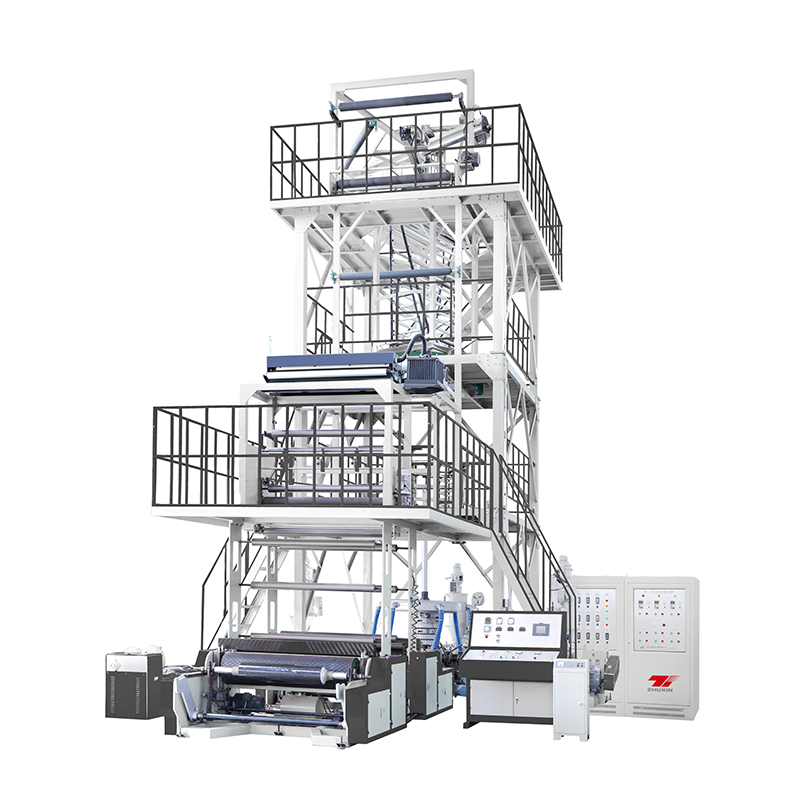
Zhuxin Machinery's ABC series three-layer co-extrusion blown film machine is engineered with features that minimize the causes of bubble instability. The three-channel co-extrusion structure supports functional laminates including heat-sealable layers, barrier layers, and abrasion-resistant layers. The patented rotary die head improves optical performance, achieving film haze of ≤3%. Optional in-line surface treatment modules are available for high-end applications like automotive interior films.
The ABC series is built to German Standard precision transmission systems, with 80% energy saving and efficiency improvement. Film width ranges from 1200–2000mm, thickness from 0.03–0.20mm, with maximum output of 250 kg/hr. Screw diameters are A:φ65, B:φ75, C:φ65. The machine supports IBC internal bubble cooling and haul-off rotary systems for consistent film quality.
Before you make significant adjustments to your ABC line, run a baseline test at your current settings. Record each layer's melt temperature, air ring pressure, cooling air temperature, and die runout. Then make one change at a time—temperature first, then air, then mechanical—and validate each change with the symptom-to-cause reference. Most instability issues resolve within an hour when you follow a systematic approach.
Struggling with bubble instability on your ABC coextrusion line? Contact Zhuxin Machinery for technical support or a quote on the 3 Layers Co-Extrusion Internal Bubble Cooling Haul-Off Rotary Film Blowing Machine. Share your current machine settings, resin types, and the instability pattern—their engineering team can provide specific tuning recommendations for your application.

 English
 Español
 Pусский