You're running a blown film line. The pressure to incorporate recycled content is real — from brand owners, from regulators, from the market. But every time you've tried adding PCR, you've seen black specks, brittle film, or processing headaches. You know the 5-layer machine can do it, but the "how" has been elusive.
A 5 layers film blowing machine is the most effective platform for processing recycled content — not because it's more powerful, but because it gives you layers to hide the PCR where it doesn't compromise film performance. The "sandwich" approach: virgin resin on the outside for strength and appearance, recycled material tucked safely in the core. Zhuxin's 5-layer co-extruded blown film line uses a modular design to support flexible combination of PE/PP and other multi-materials, achieving layer thickness uniformity error of ≤3% and reducing raw material costs by 15% or more. This guide walks through how to place recycled material in the layer structure, what ratios work for different applications, and how to adjust your process to avoid the common pitfalls of running PCR.
Hide the PCR in the middle
The layer structure of a 5-layer film is the secret to successful recycled content processing.
PCR in the middle, virgin on the outside
In a typical five-layer structure (A-B-C-D-E), the outer layers (A and E) are the "skin" — they determine surface properties like printability, sealability, and gloss. The middle layer (C) provides bulk and strength. The two intermediate layers (B and D) are the ideal place for recycled material. By placing PCR in B and D, you create a barrier between the recycled content and the film surface. Contaminants, gels, and color variations stay buried in the core where they don't affect appearance or food-contact compliance.
Keep the junk away from the surface
The outer layers of virgin material provide several critical functions: they ensure the film meets food-contact regulations (FDA or EU compliance), they provide the smooth surface needed for high-quality printing, and they maintain seal strength. The recycled material in the core contributes to the film's mechanical properties — tear strength, puncture resistance, and stiffness — without compromising the surface. For film manufacturers, this "hide the PCR" approach is the most practical way to meet sustainability targets without sacrificing quality.
Get the layer ratio right
The thickness of the core layers relative to the outer layers determines how much recycled material you can incorporate. A typical 5-layer structure might allocate 15-20% of total thickness to each outer layer, leaving 60-70% for the three core layers. This means the majority of the film can be recycled content, with only the thin outer skins made from virgin resin. Zhuxin's precise melt pump control system ensures layer thickness uniformity within ±3%, which is critical when running PCR — uneven layers can cause localized weaknesses.
How much PCR can you actually run?
The percentage of recycled material you can use depends on the application. Here's a practical guide:
| Application |
Recycled Content (B+D Layers) |
Total Film PCR |
Key Consideration |
| Garbage bags / refuse sacks |
Up to 80% |
50-60% |
Strength is the only requirement |
| Industrial liners |
50-70% |
35-50% |
Puncture resistance matters |
| Shipping sacks (FFS) |
30-50% |
20-35% |
Must survive palletizing and stacking |
| Agricultural film |
30-40% |
20-30% |
UV resistance required |
| Food-contact film (non-direct) |
25-30% |
15-20% |
Must use food-grade PCR |
| Food-contact film (direct) |
≤25% |
≤15% |
FDA-compliant PCR only |
100% PCR sounds good — doesn't work
Some suppliers promise 100% recycled films. In reality, running a 5-layer line with 100% PCR is technically possible but practically challenging. The issue isn't layer placement — it's melt strength. Recycled material has lower melt strength than virgin resin, making bubble instability more likely. For most commercial applications, the practical maximum total PCR is 40-60% for non-food films and 15-25% for food-contact films. Pushing beyond these ratios typically requires reducing line speed or adding melt strength enhancers.
25% max if it touches food
For food-contact applications, the recycled material must be food-grade PCR (post-consumer recyclate approved for food contact). Even with food-grade PCR, the recommendation is to keep total PCR below 25% of the film structure. The outer layers (A and E) should be 100% virgin food-grade resin, with the PCR confined to the B and D layers.
Filter out the junk first
Recycled material contains contaminants that virgin resin doesn't — paper labels, aluminum foil fragments, adhesive residues, and other polymers. Melt filtration is your first line of defense.
Change screens without stopping
For PCR processing, a continuous-type screen changer is essential. Unlike manual screen changers that require stopping the line, continuous changers allow you to change filters without interrupting production — critical when running PCR, which requires more frequent filter changes. A dual-piston or rotary screen changer is recommended.
Start coarse, finish fine
Start with a coarser screen (80 mesh) to catch large contaminants, followed by finer screens (150 mesh or higher) for smaller particles. The pressure drop across the screen pack will increase as contaminants accumulate — when the pressure rises 20-30% above baseline, it's time to change screens. With recycled material, you may need to change filters 2-3 times more often than with virgin resin.
Run a sample, see what's in it
Before running a large batch of recycled material, run a small sample through the extruder and inspect the screen pack. The contaminants caught on the screen tell you what you're dealing with — paper fibers, aluminum flecks, or other polymers. This audit helps you decide whether to adjust the screen mesh or reject the batch entirely.
Recycled pellets need a different screw
Recycled pellets are different from virgin resin. They have lower bulk density, different melting behavior, and higher sensitivity to shear heat.
Feed zone — deeper is better
Recycled pellets have lower bulk density than virgin pellets — they're fluffier, less dense. If the screw feed zone is too shallow, the extruder won't pull enough material, reducing output and creating melt instability. For PCR processing, the feed zone should be deepened by 15-20% compared to a virgin-only screw design.
Less squeeze, less heat
Standard PE screws have a compression ratio of 3:1. For recycled material, a lower compression ratio — around 2.5:1 — reduces shear heat. Recycled polymers have already been through one heat history; additional shear heat can cause degradation, leading to black specks and gels. A lower compression ratio gentles the melting process.
Warm the hopper, drive off moisture
Recycled pellets often contain moisture — even if they've been dried, they can absorb humidity during storage. Pre-heating the hopper to 60°C drives off surface moisture before the material enters the extruder. This prevents steam bubbles in the melt, which cause pinholes and weak spots in the film.
Black specks — the PCR headache
Black specks are the most visible defect from running recycled material. They come from degraded polymer — material that's been overheated or has sat too long in the extruder.
Gels don't melt — they speck
Recycled material often contains crosslinked gels — tiny particles of degraded polymer that don't melt at normal processing temperatures. These gels pass through the screen pack (if they're small enough) and end up as black specks in the film. The problem is worse with post-consumer recyclate, which has been through more heat history.
PPA makes PCR run smoother
Adding a polymer processing aid (PPA) — typically a fluoropolymer-based additive — reduces melt fracture and die buildup. PPA coats the die walls, reducing the residence time of degraded polymer and preventing it from sticking. For PCR processing, PPA is almost mandatory at 500-1000 ppm.
Purge often, purge clean
Schedule regular purging with a commercial purge compound. Run the purge compound through the extruder at full operating temperature, then push it through with virgin resin. This removes degraded material that has accumulated on the screw flights and in the die channels. For lines running high PCR content, purge every 8-12 hours of operation.
Three questions about running PCR
Q: One extruder or two — what's needed?
A: Not necessarily. In a 5-layer line, the recycled material can be fed through one or two of the existing extruders (typically the B and D extruders). However, you need to ensure that the screw design in those extruders is optimized for PCR — deeper feed zone, lower compression ratio. If you're running high PCR content (above 50%), consider dedicating one extruder exclusively to recycled material.
Q: PI and PC — can you blend them?
A: Yes, but with caution. Post-industrial (PI) recyclate is typically cleaner and more consistent — it's scrap from your own production line. Post-consumer (PC) recyclate is more variable and contains more contaminants. A common approach is to blend PI and PC recyclate in the core layers, using the PI to "dilute" the contaminants in the PC. Start with a 70/30 PI/PC blend and adjust based on film quality.
Q: No lab? Here's a field check
A: Run a small batch of the recycled material through the extruder at low speed and inspect the screen pack. The contaminants caught on the screen — paper fibers, aluminum flakes, other polymers — tell you what you're dealing with. Also, inspect the film for black specks and gels under bright light. If you see more than 5 specks per square meter, the contamination level is too high for commercial film.
The machine that makes PCR work
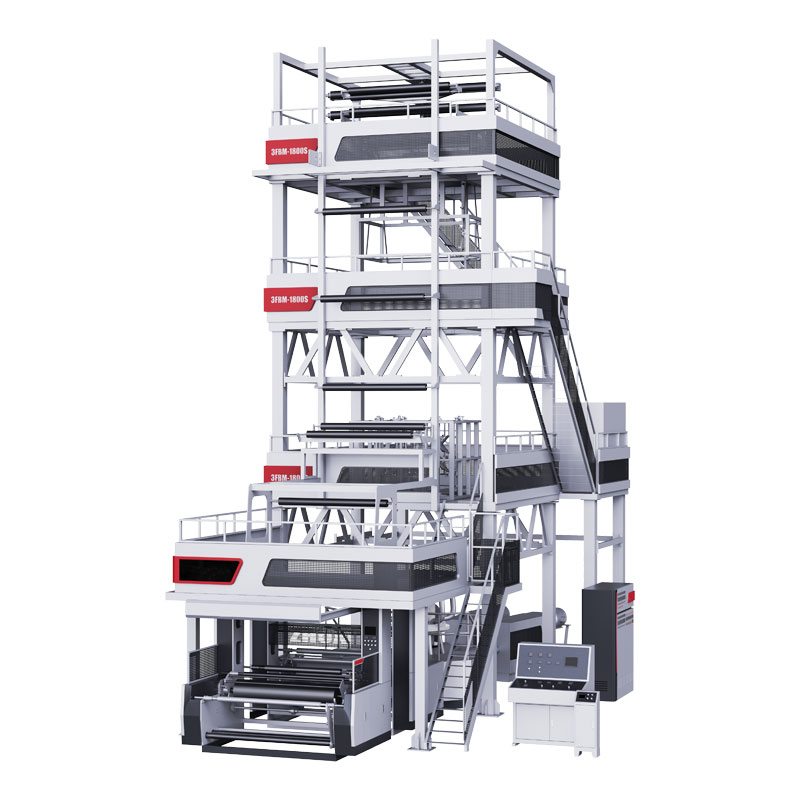
Zhuxin Machinery's 5-layer co-extruded blown film machine is engineered for the challenges of PCR processing. The modular design supports flexible combination of PE/PP and other multi-materials, enabling precise layer distribution for "hiding" recycled content in the core layers. The precise melt pump control system maintains layer thickness uniformity within ±3%, which is critical when running PCR — even layer distribution prevents localized weaknesses.
The line features a German Standard precision transmission system with 80% energy saving and efficiency improvement. Film width is 1000mm, thickness range 0.10-0.25mm, with maximum output of 250-300 kg/h. With over 2000 successful cases worldwide, Zhuxin has the application experience to help you dial in your PCR process.
Before you commit to a recycled material supplier or a new layer structure, run a trial. Send 5kg of your recycled material to Zhuxin — their technical team will run it through the 5-layer line and provide a recommendation on optimal layer placement, screw settings, and expected mechanical properties.
Ready to start processing recycled content on your 5-layer line? Contact Zhuxin Machinery for a free trial run with your recycled material. Share your target application, PCR type (post-industrial or post-consumer), and desired recycled content percentage — their technical team can recommend the optimal layer structure and machine settings for your specific material.

 English
 Español
 Pусский