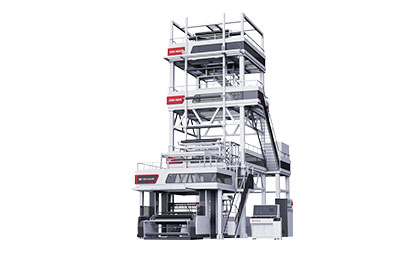
You run a flexible packaging line. The price of virgin LDPE has climbed again. Your competitors who switched to ABA co‑extrusion are still quoting the same price per bag that you were losing money on six months ago. They are not absorbing the cost. They are hiding recycled material between two thin skins of virgin resin where customers cannot see it and where it does not affect printability or heat seal strength.
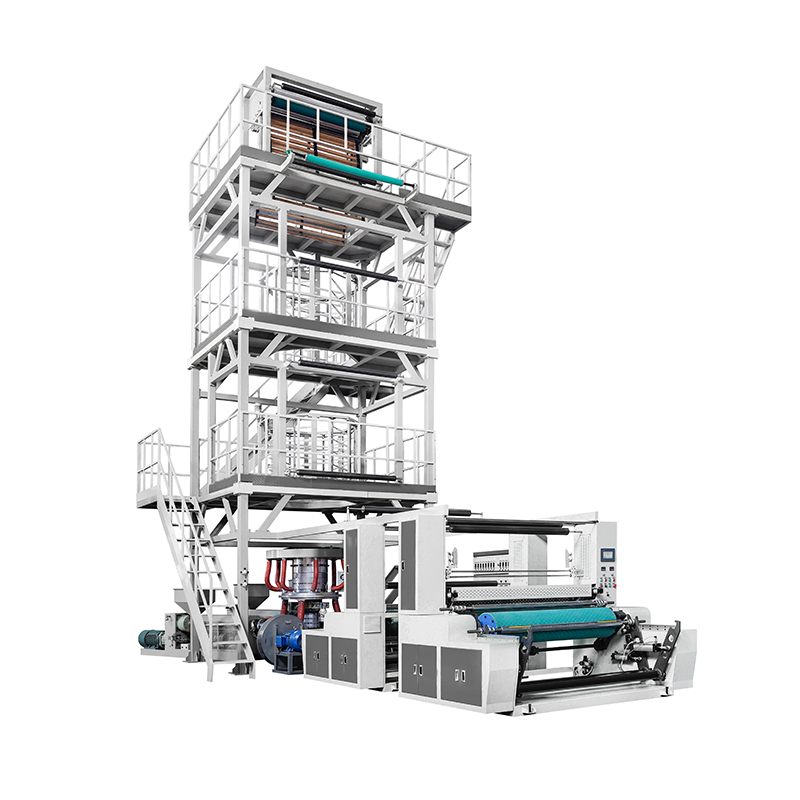
A film blowing machine configured for three‑layer co‑extrusion with a rotary die head does exactly that. The extruder arrangement is A/B/A: two screws for the outer layers (the “A” surfaces) and a third screw for the core layer. The ABC film blowing machine from Zhuxin Machinery uses this architecture to produce barrier films, heavy‑duty shipping sacks, and shrink wrap at up to 250 kilograms per hour, with a lay‑flat width of 1200‑2000mm and thickness from 0.03mm to 0.20mm.
This guide walks through what the numbers on the datasheet actually deliver in daily operation: how the screw diameters (φ65, φ75, φ65) work together, where the 250kg/hr output comes from, the film width and thickness ranges that determine which orders fit, and the three real‑world checks every buyer should run before plumbing a three‑layer line into the production hall.
The screw diameters tell you which extruder handles which layer
The ABC configuration on this film blowing machine platform uses three separate extruders, each with a different screw diameter. The two outer extruders (A layer) are φ65mm. The center extruder (B layer) is a larger φ75mm screw. That diameter difference is deliberate. The core layer runs more volume because it accounts for approximately 50-70% of the total film thickness, depending on the A/B/A ratio set by the operator. The larger screw in the center provides the extra melt capacity required to fill that thicker middle section without slowing down the outer extruders.
| Extruder Position |
Screw Diameter |
Function |
Typical Volume Share |
| A layer (outer) |
φ65mm |
Virgin resin – surface gloss, printability |
15-25% each |
| B layer (core) |
φ75mm |
Recycled or filled resin – cost reduction |
50-70% |
| A layer (outer) |
φ65mm |
Virgin resin – surface gloss, heat seal |
15-25% each |
The L/D ratio is 30:1 for all three screws. That longer barrel length ensures complete melting and mixing of the feed stock, which is especially important for the core layer if it contains higher percentages of recycled content with variable melt flow characteristics.
Rotary die head – why the die rotates and what that does to gauge uniformity
The rotary die head is the feature that separates a co‑extrusion line from a basic mono‑layer extruder. The entire die assembly rotates continuously during production, typically at a speed of 0.5 to 2 revolutions per minute. The rotation distributes any remaining gauge variation across the entire circumference of the bubble instead of concentrating it in a fixed circumferential band.
On a non‑rotating die, a small unevenness in the die gap creates a thick stripe that repeats at the same position on every roll. That stripe becomes a weak point in the bag or a location where printing registration drifts. On a rotary die, that same unevenness moves around the bubble, spreading the thick spot over a wider area and reducing the peak‑to‑peak variation in final film thickness.
The result is a flatter roll that unwinds more consistently on bag‑making machines, with fewer breaks and less scrap. For converters running high‑speed bag lines, a rotary die head can improve machine uptime by 5-10% simply by delivering more uniform rolls from the extrusion step.
Output and material range – 250kg/hr from ABC configuration
The ABC three‑layer co‑extrusion film blowing machine is rated for a maximum output of 250 kg per hour. That figure assumes running LDPE at standard melt temperatures with a film thickness in the middle of the 0.03‑0.20mm range. Running HDPE or LLDPE blends will reduce output by 15-25% because those materials require more torque per kilogram.
The film width range is 1200mm to 2000mm lay‑flat width after the bubble is collapsed. The width is adjustable by changing the inflation pressure and the nip roll gap. For a bag converter running 1500mm wide rolls, the 2000mm maximum provides enough headroom to produce wider rolls and slit them down, which spreads die change costs over more kilograms of output.
Paper weight equivalency — since the machine processes polyethylene, the “paper weight” concept does not apply directly. The thickness range covers light hand‑wrap film (0.03mm) up to heavy‑duty industrial sacks and agricultural mulch (0.20mm).
What the thickness range covers in real packaging terms
| Thickness (mm) |
Typical Application |
Output Speed Relative to Max |
| 0.03mm (30 microns) |
Lightweight produce bags, stretch hand wrap |
Fastest (near 250kg/hr) |
| 0.06mm (60 microns) |
Standard T‑shirt bags, liners |
85-90% of max |
| 0.10mm (100 microns) |
Heavy‑duty shipping sacks, industrial liners |
70-80% of max |
| 0.20mm (200 microns) |
Agricultural film, pond liners, heavy shrink |
50-60% of max |
The business case for ABA co‑extrusion – where the material savings actually come from
A mono‑layer film blowing machine runs 100% virgin resin for every order. The cost per kilogram is the market price of LDPE, HDPE, or LLDPE. An ABA three‑layer line runs virgin resin only on the two outer surfaces, which together make up 30‑50% of the total thickness depending on the A/B/A ratio. The core layer can be filled with recycled post‑industrial resin (PIR), post‑consumer recycled (PCR), or calcium carbonate masterbatch.
For a 50‑micron shopping bag with an A/B/A ratio of 20/60/20, only 40% of the resin is virgin. The remaining 60% can be recycled material that costs 30‑40% less per kilogram than virgin. The blended material cost per kilogram of finished film drops by approximately 18‑24% compared to an all‑virgin bag.
The math works out: a bag converter processing 2,000 kg of film per day reduces material cost by 300‑300‑400 per day at current resin prices. The three‑layer co‑extrusion line pays for its premium over a mono‑layer line in 12‑18 months of normal operation.
Three production checks before buying an ABC film blowing line
Check 1 – Layer ratio uniformity across the die circumference
After the line stabilizes at operating temperature and speed, take a sample of the bubble film. Use a microscope or layer‑profiling instrument to measure the relative thickness of A layers versus B layer at eight points around the circumference. The A layer thickness should not vary by more than ±10% of the target. Higher variation means the die gap or individual extruder output is not concentric, and the final film will have weak spots that bag‑making equipment will find.
Check 2 – Melt temperature matching between the three screws
If the core layer exits the die at a significantly different temperature than the outer layers (more than 10°C difference), the interface between layers will have poor adhesion. The film will delaminate when folded or when seals are applied. Check the actual melt temperature at the die adapter for each extruder. Adjust the barrel zone temperatures on the center extruder to bring its melt temperature within 5°C of the outer extruders.
Check 3 – Bubble stability during a resin changeover
Switch the core layer from virgin LDPE to recycled material while the line is running at 80% of full speed. Watch the bubble for wobble or frost line height change. A machine with good screw design and die geometry will maintain stable bubble dimensions without operator intervention. If the bubble collapses or the frost line jumps more than 10cm, the machine’s screw and die combination lacks the flexibility needed for a converter using variable feedstocks.
How the ABC three‑layer rotary die film blowing machine fits into a flexible packaging plant
Zhuxin Machinery has built blown film extrusion lines since 1989, with more than 2,000 installations worldwide. The ABC three‑layer co‑extrusion rotary die head platform is their upgrade path for converters moving from mono‑layer to co‑extruded film production.
The machine is supplied with a die head diameter matched to the target film width, an air ring for bubble cooling, a collapsing frame with nip rollers, and a surface or gap winder for roll take‑up. Controls are PLC‑based with HMI touchscreen for setting A/B/A ratios, extruder speeds, and winding tension. The drive system is German‑standard gearing with frequency converters for each screw.
For a film blowing machine that puts recycled resin where it belongs—hidden between two thin layers of virgin material—the ABC three‑layer co‑extrusion platform with rotary die head delivers consistent gauge uniformity, lower material costs, and a payback period that most packaging converters can hit within two years.
【Request a quote from Zhuxin Machinery】

 English
 Español
 Pусский