You're spec'ing a new AB blown film line, or maybe you're replacing the die head on an existing machine. The die diameter is one of the most critical decisions you'll make—and it's also one of the most misunderstood.
A die that's too large wastes material and increases degradation risk. A die that's too small limits your film width and output. Get it right, and you'll maximize production efficiency while maintaining film quality. Your AB Film Blowing Machine relies on the die head to shape the molten polymer into a stable bubble—and that bubble determines everything that follows.
This article answers seven of the most common questions about die diameter selection for AB film blowing machines—covering everything from layflat width relationships to blow-up ratio choices and material compatibility. For B2B buyers and production engineers, this is practical guidance for making a confident equipment decision.
Die Size vs. Film Width – The Real Link
The relationship between die diameter and final film width isn't direct—it's mediated by the blow-up ratio (BUR).
The Formula
The layflat width is approximately equal to: Die Diameter × π / 2 × Blow-Up Ratio. In simpler terms: a larger die diameter allows you to produce a wider film at the same BUR, or achieve the same width at a lower BUR.
The Practical Implication
If you know your target layflat width and the BUR you plan to run, you can work backward to determine the die diameter you need. For example, if you need a 1000mm layflat width and you plan to run at a BUR of 3:1, you'd need a die diameter of roughly 100-110mm. The AB film blowing machine from Zhuxin Machinery achieves a maximum output of 180-220kg/h with a film width of 1000-1500mm, demonstrating the practical range of die size selection.
Why This Matters
Choosing a die diameter that's mismatched to your target width forces you to run at either an excessively high or low BUR—both of which compromise film properties.
Right Size for Your Width
Here's a practical reference guide for matching die diameter to layflat width.
Reference Table
| Target Layflat Width |
Recommended Die Diameter Range |
Typical BUR Range |
| 200-400mm |
50-80mm |
2.0-3.5 |
| 400-700mm |
80-120mm |
2.0-3.5 |
| 700-1000mm |
120-180mm |
2.0-3.5 |
| 1000-1500mm |
180-250mm |
2.0-3.5 |
| 1500-2000mm |
250-350mm |
2.0-3.5 |
The Range Concept
These are ranges, not fixed values. The optimal die diameter depends on your specific material, film thickness, and desired film properties. A die at the smaller end of the range will run at a higher BUR; a die at the larger end will run at a lower BUR.
Bigger Isn't Always More Output
No—and this is one of the most common misconceptions in die selection.
The Limiting Factor Is Extrusion Capacity
A larger die doesn't create more output—it just spreads the same output over a wider area. If your extruder can only deliver 180kg/hr, a larger die won't increase that number. The output is limited by the screw diameter and extruder capacity—Zhuxin's AB machine uses φ60+φ65 screws, which determines the melt delivery rate.
The Degradation Risk
An oversized die creates longer melt residence time. The polymer sits in the die longer, increasing the risk of thermal degradation. This is particularly problematic for heat-sensitive materials like LLDPE and certain barrier resins.
The Rule of Thumb
A general guideline: each inch of die diameter can support approximately 1.5-2.5 kg/hr of output, depending on the material and processing conditions. If your die is significantly larger than what your extruder can feed, you're wasting money and risking quality issues.
Low BUR or High BUR?
The blow-up ratio (BUR) is the ratio of the final bubble diameter to the die diameter. Your choice affects film properties directly.
Low BUR (Below 2.0)
A low BUR produces higher film transparency and better optical properties. The film is stretched less in the transverse direction, resulting in more balanced orientation. Low BUR is ideal for thin films, packaging films where clarity matters, and applications where optical quality is a priority.
High BUR (2.5 to 4.0)
A high BUR produces higher transverse direction (TD) strength. The film is stretched more in the transverse direction, creating greater molecular orientation and higher tear resistance in the TD. High BUR is ideal for heavy-duty bags, industrial packaging, and applications requiring high impact strength.
Making the Choice
The decision depends on your end-use application. If you're producing food packaging film where clarity matters, choose a lower BUR. If you're producing heavy-duty shipping sacks or industrial bags, choose a higher BUR. The AB film blowing machine's double-layer co-extrusion design allows you to optimize each layer independently—functional layer and substrate layer—to achieve the right balance of properties.
Retrofit Your Existing Line
Yes—but it's not a simple swap.
What's Involved
Changing the die diameter typically requires replacing the die head itself, and potentially the die adapter and air ring as well. The adapter must match the new die's mounting dimensions. The air ring must be sized for the new bubble diameter.
The Process
The general approach is: remove the existing die head, install the new die adapter (if needed), mount the new die head, and recalibrate the air ring and cooling system. Then run trials to establish new processing parameters—temperature profile, output rate, and BUR.
When It Makes Sense
Die changes are most cost-effective when you're significantly expanding your product range—for example, moving from narrow films to wide films, or from thin films to heavy-gauge films. For minor adjustments, it's often more economical to adjust your BUR within the existing die's range.
Why Land Length Matters
Yes—die land length affects film uniformity and processing stability.
What Die Land Length Is
The die land is the straight section at the exit of the die where the polymer flows before exiting. A longer land length provides more residence time for the polymer to relax, which improves thickness uniformity across the film width.
The Trade-Off
Longer land length improves uniformity but increases back pressure. Higher back pressure means the extruder works harder, which can increase energy consumption and potentially cause degradation for heat-sensitive materials.
Recommendation for AB Configuration
For AB film blowing machines, a land length of 30-40mm is generally recommended. This provides good thickness uniformity without excessive back pressure. The double-layer co-extrusion design of Zhuxin's AB machine uses independent temperature-controlled extrusion systems, which helps compensate for any minor uniformity issues.
Know Your Materials
Not all materials are suitable for all die designs. Understanding material compatibility is essential.
Compatible Materials
AB film blowing dies are typically designed for LDPE, LLDPE, HDPE, and EVA. These materials have good melt flow characteristics and don't require special die designs. Zhuxin's AB machine is specialized for food composite packaging and industrial heavy packaging, which typically use these material families.
Materials to Avoid
High-viscosity engineering plastics like polycarbonate (PC) are generally not suitable for standard AB dies. These materials require specialized screw and die designs to handle their high melt viscosity and narrow processing windows.
Material-Specific Considerations
Different materials have different optimal BUR ranges. LLDPE typically runs well at BURs of 2.5-3.5. HDPE prefers lower BURs of 1.5-2.5. LDPE is more forgiving, running well across a wider BUR range. When selecting a die, consider the primary materials you'll be processing.
Questions Buyers Ask
What happens if I choose a die that's too large for my extruder?
You'll have longer melt residence time, which increases the risk of thermal degradation. The polymer sits in the die longer, potentially developing gels and black specks. You'll also have higher die pressure without any increase in output—meaning you're wasting energy and risking material degradation without any production benefit.
How do I know what BUR to target for my application?
Start with your end-use requirements. If you need optical clarity, target a BUR below 2.0. If you need transverse direction strength (for heavy-duty bags), target a BUR of 2.5-4.0. If you're unsure, run trials at different BURs and test the film properties. The AB machine's independent temperature control for each layer allows you to fine-tune processing conditions.
Can I use the same die for LDPE and HDPE?
Yes, but you may need to adjust your BUR and processing conditions. HDPE typically requires a lower BUR than LDPE for the same film width. If you're switching materials frequently, choose a die diameter that allows you to run both materials within their optimal BUR ranges. The double-layer design of the AB machine gives you additional flexibility—you can run different materials in different layers.
Summary Checklist Before Ordering
Before you place your die order, make sure you can provide your supplier with these key specifications:
Information to Provide
-
Target layflat width: What finished film width do you need?
-
Primary raw materials: LDPE, LLDPE, HDPE, EVA, or blends?
-
Each layer thickness ratio: For AB configuration, what's the split between layer A and layer B?
-
Expected BUR range: Based on your application requirements
-
Film thickness range: Thin film, heavy-gauge, or both?
Zhuxin Machinery has been specializing in blown film technology since 1989, with over 2000 successful cases worldwide. Their AB Film Blowing Machine features independent temperature-controlled double extrusion systems, achieving a peel strength improvement of 30% through unique interlayer melt fusion technology. The production capacity reaches 220kg/h at 2.5m width, with German Standard precision transmission systems delivering 80% energy saving and efficiency improvement.
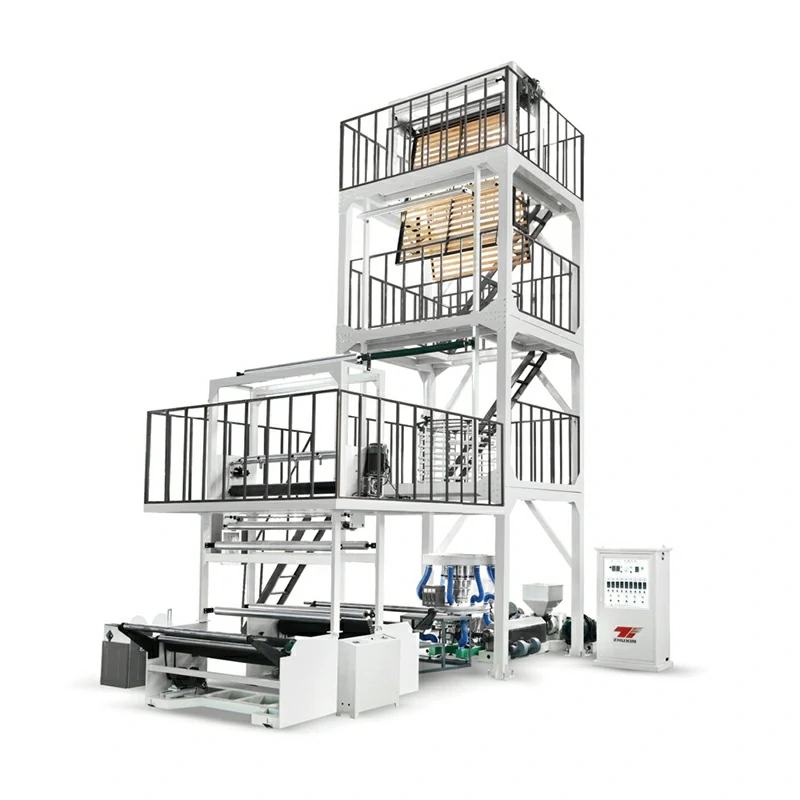
The Double-Layer Co-Extrusion Rotary Die Head Film Blowing Machine Set offers film widths of 1000-1500mm, thickness range of 0.03-0.20mm, and maximum output of 180kg/hr. With screw diameters of φ60+φ65, the machine is specialized for food composite packaging and industrial heavy packaging markets.
Selecting the right die diameter is one of the most important decisions in specifying an AB film blowing machine. It affects your output, film width, product quality, and operating costs. Use the guidelines above to determine your target layflat width, choose an appropriate BUR range, and work with your supplier to select a die diameter that matches your extruder capacity and material requirements. With the right die, your AB film blowing machine will deliver consistent, high-quality film for years to come.
Ready to spec the right die for your AB film blowing machine? Reach out to Zhuxin Machinery's technical team—they can provide die selection guidance, material compatibility recommendations, and custom die designs based on your specific production requirements.

 English
 Español
 Pусский