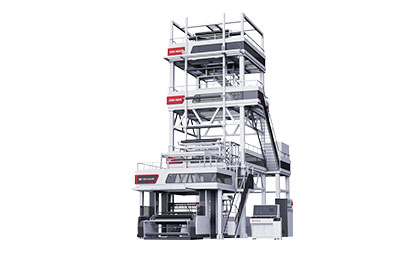
You run a blown film line. The bubble rises, cools, flattens, and winds into rolls. Then those rolls go to a separate printing line—unwind, print, rewind. That extra handling adds labour, storage space, and at least one shift of production time. A film blowing machine with an inline flexo printing station changes that arithmetic. Zhuxin's PE Extruder And Printing Machine (FLEXO) extrudes, prints, and rewinds in one pass. This guide walks through real specifications: output by model, film width ranges, the 32:1 L/D screw, how the printing unit integrates, and three field checks you can run before buying.
Five models: what output and width each one delivers
The line comes in five extruder sizes. The table below shows the key numbers.
| Model |
SJ-P45 |
SJ-P50 |
SJ-P55 |
SJ-P60 |
SJ-P65 |
| Screw dia (mm) |
φ45 |
φ50 |
φ55 |
φ60 |
φ65 |
| Film width (mm) |
100-500 |
300-600 |
400-800 |
500-1000 |
600-1200 |
| Max LD output (kg/hr) |
50 |
55 |
65 |
75 |
100 |
| Max HD output (kg/hr) |
40 |
45 |
55 |
60 |
60 |
| HD thickness (mm) |
0.009-0.10 |
0.009-0.10 |
0.009-0.15 |
0.009-0.15 |
0.009-0.15 |
| LD thickness (mm) |
0.02-0.15 |
0.02-0.15 |
0.03-0.15 |
0.03-0.15 |
0.03-0.15 |
| Main motor (kW) |
11 |
15 |
18.5 |
22 |
22 |
*Data from product page [7†L23-L35]*
HDPE output runs lower than LDPE because HDPE is denser and requires more torque per kilogram. The SJ-P65 pushes 100kg/hr of LDPE but only 60kg/hr of HDPE—normal for a single‑screw machine. The thickness range spans from 0.009mm (9 microns, shrink wrap territory) to 0.15mm (industrial heavy‑duty liners).
The 32:1 L/D screw: why longer matters for printed film
Melt uniformity drives print quality
Mono‑layer extrusion for commodity film sometimes uses 24:1 or 28:1 screws. But when you add an inline printing station, melt uniformity becomes critical. Inconsistent melt temperature or unmelted particles cause gauge bands—stripes of thicker and thinner film across the web. When those bands pass under the printing cylinder, the ink lays down unevenly.
The 32:1 L/D ratio across all five SJ‑P models provides five heating zones [7†L31-L32]. You can profile the barrel: cooler at the feed section, hot through compression, and a precisely tuned metering section. The result is a more homogeneous melt that prints cleanly.
German‑standard transmission
Extruder uptime depends on the gearbox. The line uses a precision transmission system built to German standards—helical gearing, high surface hardness, oversized bearings, and oil‑bath lubrication [0†L6-L7]. For a film blowing machine running two shifts, gearbox reliability is not optional.
How the inline printing unit works
The printing station mounts after the main nip rollers and before the winder. The body is square steel, with frequency converter controlled traction, a friction single winder, and an elevator [7†L14-L16]. Printing speed synchronises with extrusion take‑up speed through the PLC.
Gravure or flexo – you can switch
The gravure printing heads can be changed to flexo printing heads [7†L22-L23]. Gravure offers sharper detail for fine text. Flexo handles coarser screens and large colour areas more economically. A bag manufacturer printing simple 1‑ or 2‑colour logos may prefer flexo; a medical packaging converter printing fine calibration marks may prefer gravure.
Single‑ and double‑side printing in one pass
The unit prints both single‑sided and double‑sided without stopping. Colour register can be adjusted at any time—the 360‑degree register system does not stretch the film [7†L18-L21]. A far‑infrared tube dryer runs at 50% per minute evaporation rate, sufficient for water‑based and solvent‑based inks at typical 40‑60m/min line speeds [7†L21-L22].
-1157.jpg)
Materials you can run
The product page lists HDPE, LDPE, and LLDPE across all five models [7†L24-L25]. That covers most commodity packaging resins.
Surface tension on PE film is low (31‑34 dynes/cm) after extrusion. Most water‑based flexo inks require corona treatment to raise surface energy to 38‑42 dynes/cm for adequate adhesion. An inline corona treater can be added between the nip and the print station.
Footprint and power: what fits your floor
| Model |
Length (m) |
Width (m) |
Height (m) |
| SJ-P45 |
5.0 |
2.0 |
4.1 |
| SJ-P50 |
5.0 |
2.1 |
4.5 |
| SJ-P55 |
5.5 |
2.3 |
5.2 |
| SJ-P60 |
5.8 |
2.8 |
6.3 |
| SJ-P65 |
5.8 |
2.6 |
6.3 |
*Data from product page [7†L37-L38]*
The height increases from 4.1m to 6.3m as film width expands. For the SJ-P65, building ceiling height must be at least 7.0m.
Main motor power scales from 11kW to 22kW [7†L34-L35]. The take‑up motor is 0.75‑1.5kW, and the winding motor torque is 10‑16 N·m across all models [7†L35-L36].
Three field tests before you buy
Request a witnessed factory acceptance test with these three checks:
-
Register accuracy at full speed – Print a multi‑colour pattern with fine registration marks. Run at max output for 30 minutes. Stop without slowing down. Registration drift should not exceed ±0.5mm between colours.
-
Gauge variation under print – Measure thickness across the web at 10 points every 100mm. Variation should be ≤±5% of nominal. Moving gauge bands indicate unstable bubble cooling.
-
Double‑side print alignment – Print a pattern that crosses from front to back. Front‑to‑back registration should be within ±1mm.
Applications and how the machine fits into Zhuxin's portfolio
The product page lists supermarket flat bags, shopping bags, plastic vest bags, and flat plastic film as primary applications [7†L12-L14]. A film blowing machine with inline printing reduces labour and handling for a converter running printed commodity bags.
The machine is part of Zhuxin Machinery's blown film range. Zhuxin has specialised in blown film since 1989 with over 2,000 installations worldwide [0†L6-L8]. The warranty is 12 months from delivery, with after‑sales support including phone, online chat, and on‑site expatriate personnel [8†L44-L54].
【Request a quote from Zhuxin Machinery】

 English
 Español
 Pусский