Fresh meat, cheese, ready-to-eat meals—these foods share one vulnerability: oxygen. Even small amounts of oxygen can spoil flavor, shorten shelf life, and compromise food safety. Traditional single-layer or two-layer films can‘t provide the barrier performance that modern food packaging demands.
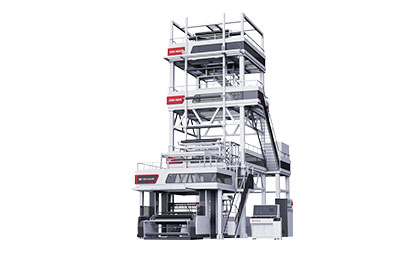
An ABC Film Blowing Machine addresses this challenge through three-layer co-extrusion, combining different materials into a single film where each layer serves a specific function. By using EVOH or Nylon as a barrier layer, the ABC structure can reduce oxygen transmission rates to <1 cc/m²/day, dramatically extending product shelf life.
This guide covers why the ABC structure works for high-barrier applications, how to select the right barrier resin, layer thickness strategies, temperature control for EVOH processing, and quality testing methods.
A Layer, B Layer, C Layer — Each Does a Different Job
Seven-layer and nine-layer coextrusion lines exist, but they come with high capital costs and operational complexity. The ABC structure offers a practical alternative that meets most barrier requirements with just three layers.
A Layer – Outer Protection
The A layer serves as the outer surface of the film. It provides mechanical strength, puncture resistance, and printability. Common materials include LDPE or LLDPE, which offer good toughness and a surface suitable for high-quality printing.
B Layer – The Barrier Core
The B layer is the functional core of the ABC structure. This is where the barrier performance comes from. EVOH (ethylene vinyl alcohol) or Nylon 6 are the primary choices. EVOH offers extremely low oxygen transmission rates (<1 cc/m²/day) in dry conditions, while Nylon provides moderate barrier with better moisture resistance.
C Layer – Heat-Sealable Inner
The C layer forms the inner surface that contacts the food. It must be heat-sealable and food-contact compliant. EVA or mLLDPE are common choices, providing strong, consistent seals across a range of temperatures.
EVOH or Nylon — Choosing the Right Barrier
The choice between EVOH and Nylon depends on the product‘s moisture content and the packaging’s intended use.
EVOH – Maximum Oxygen Barrier
EVOH provides the highest oxygen barrier of any commercially available polymer. In dry conditions, OTR can be below 1 cc/m²/day. However, EVOH is moisture-sensitive—as humidity increases, its barrier performance degrades. For dry foods like coffee, nuts, and snacks, EVOH is the preferred choice.
Nylon 6 – Balanced Performance
Nylon 6 offers moderate oxygen barrier with OTR typically in the range of 20-40 cc/m²/day. Its key advantage is moisture resistance. Nylon maintains its barrier properties even in high-humidity environments, making it suitable for fresh meat, cheese, and refrigerated products.
Selection Guide Based on Product Water Activity
| Product Type |
Water Activity |
Recommended Barrier Resin |
| Coffee, nuts, snacks |
Low (<0.6) |
EVOH |
| Cheese, processed meat |
Medium (0.6-0.85) |
EVOH or Nylon |
| Fresh meat, seafood |
High (>0.85) |
Nylon 6 |
| Frozen products |
High (ice) |
Nylon 6 |
80/15/5 — Getting the Thickness Right
Getting the layer thickness right is as important as choosing the right materials. The barrier layer needs sufficient thickness to be effective, but excessive thickness wastes material and increases cost.
The General Guideline
A common starting point is the 80/15/5 rule: A layer at 80% of total thickness, B layer at 15%, and C layer at 5%. For a 60μm total thickness, this gives A layer 48μm, B layer 9μm, and C layer 3μm.
Why Barrier Layer Thickness Matters
The B layer must be thick enough to avoid pinholes. If the barrier layer is too thin—below 5μm—the risk of pinholes increases dramatically. Pinholes compromise the barrier and allow oxygen to pass through, defeating the purpose of the structure. For EVOH, a minimum thickness of 5-8μm is recommended for reliable barrier performance.
Adjusting for Product Requirements
Different products require different barrier levels. For high-oxygen-sensitivity products like coffee, consider increasing the EVOH layer to 10-12μm. For products with moderate oxygen sensitivity, 5-8μm of EVOH may be sufficient. The Zhuxin ABC machine can produce thicknesses from 0.03-0.20mm, providing the flexibility to optimize layer ratios for different applications.
Hold EVOH at 200–220°C — ±5°C Matters
EVOH has a narrow processing window. Managing temperature across the die is critical for consistent barrier performance.
The Processing Window
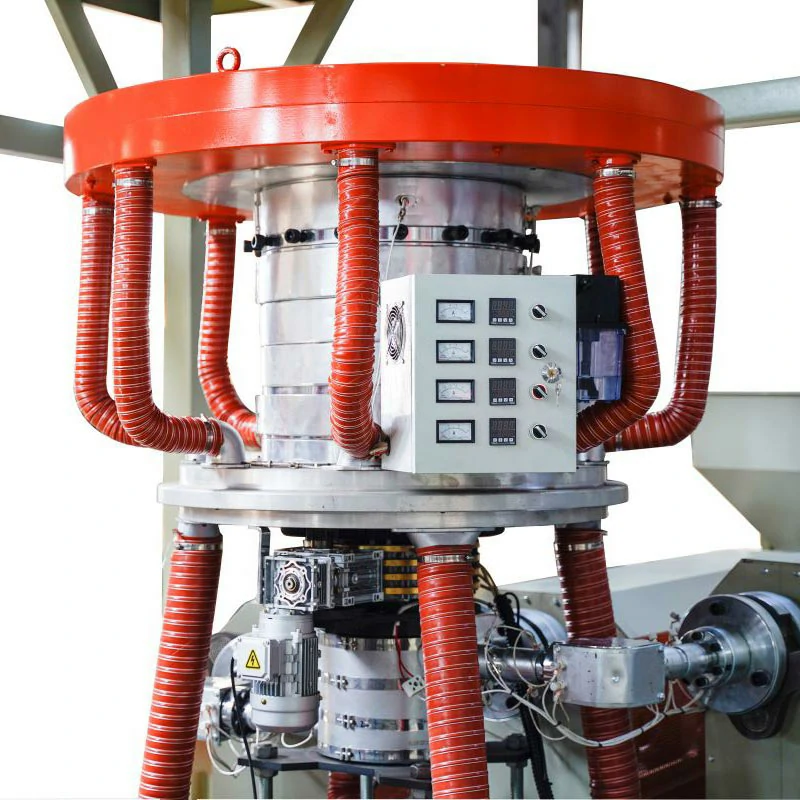
EVOH processes effectively in the range of 200-220°C. Below this range, the polymer doesn‘t melt uniformly. Above it, the resin begins to degrade, creating gels and reducing barrier performance. The temperature must be controlled within ±5°C across the die.
Independent Zone Heating
The die should have independent temperature control zones for each layer. This allows the EVOH layer to be maintained at its optimal temperature while the A and C layers run at their own setpoints. Zhuxin’s patented rotary die head improves film optical performance to ≤3% haze, and independent temperature control helps maintain the narrow EVOH window.
Cooling Considerations
After the film exits the die, cooling must be managed to prevent crystallization issues in EVOH. Rapid cooling can reduce the crystallinity of EVOH, slightly improving its barrier properties. The internal bubble cooling system on Zhuxin‘s machines supports efficient cooling for barrier film production.
Measure OTR Every Week — Catch Problems Early
Quality control doesn’t stop at the die. Regular testing ensures the film delivers the barrier performance your customers expect.
Oxygen Transmission Rate Testing
OTR testing is the most direct measure of barrier performance. For EVOH-based films, OTR should be measured in both dry and humid conditions. A simple method is to run a test coupon on an OTR instrument at 23°C and 0% RH, then again at 23°C and 85% RH. The difference tells you how much humidity affects the barrier.
Oxidation Induction Time
For films with EVOH, the oxidation induction time can provide a quick indication of barrier integrity. A shorter induction time suggests that oxygen is penetrating the film more rapidly—a sign that the barrier layer may have pinholes or degradation.
Weekly Testing Protocol
Establish a weekly testing protocol: measure OTR on a sample from each production run. Track the results over time. If OTR begins to increase, investigate the cause—temperature drift, material changes, or die contamination—before the problem affects a full production run.
What Food Packaging Engineers Ask Most
Is ABC enough for retort pouches?
Generally, no. Retort pouches require higher temperature resistance than the ABC structure can provide. For retort applications, consider a five-layer structure with polypropylene in the sealant layer and aluminum foil or EVOH in the barrier layer. The ABC structure is best suited for non-retort applications like cold-fill, hot-fill, and ambient-temperature packaging.
Can I replace EVOH with coated film?
Yes, but with trade-offs. Coated films (PVdC-coated or ceramic-coated) can provide similar barrier performance at lower cost. However, coatings add a separate process step, can be damaged during converting, and may not be recyclable. EVOH coextrusion integrates the barrier into the film structure, providing more consistent and durable performance. Zhuxin‘s ABC machine supports in-line surface treatment for additional functionality.
How to recycle barrier film scrap?
Barrier film scrap—especially with EVOH—requires special handling. EVOH is not compatible with standard polyethylene recycling streams. The best practice is to collect barrier film scrap separately and send it to a specialized recycler who can separate the materials. Some manufacturers use scrap as a core layer in non-barrier applications, but this requires careful quality control.
Ready for Higher Barrier?
The ABC three-layer structure is a proven solution for a wide range of high-barrier food packaging applications. For dry foods like coffee and nuts, EVOH provides the oxygen barrier needed to extend shelf life from months to years. For fresh and refrigerated products, Nylon offers the moisture-resistant barrier that keeps food fresh.
Zhuxin Machinery has been specializing in blown film technology since 1989, with over 2,000 successful cases worldwide. The company‘s three-layer co-extrusion rotary die head film blowing machine features a German-standard precision transmission system with 80% energy saving and efficiency improvement. Film width ranges from 1200-2000mm, thickness from 0.03-0.20mm, and maximum output reaches 250kg/hr. The patented rotary die head improves optical performance to ≤3% haze.
Request Your Barrier Film Calculation Table
Understanding the right layer structure for your specific food packaging application requires careful calculation. EVOH thickness, total film thickness, and material selection all affect barrier performance and cost.
Request Zhuxin’s barrier film calculation table — or reach out to the technical team for application support. They can help you select the right layer ratios, materials, and processing conditions for your specific product requirements.

 English
 Español
 Pусский