If you're new to plastic bag production and looking for a machine, you'll see the term "high speed" everywhere. Almost every vendor displays it on their product page. But what exactly does "high speed" mean? 100 bags per minute? 200? Some factories claim their machines can reach 400 or more.
After working with bag-making machines for several years, I've found this to be one of the most confusing aspects for new buyers. Choosing the highest number doesn't necessarily mean it's the best option. In this article, I'll explain the 200-400 pcs/min range, which is what most factories actually mean by "high speed," and help you determine if this speed is right for your business.
First, what does "pcs/min" mean?
It's simple: pieces per minute. The number of finished bags the machine produces in one minute. But an important detail is often overlooked: you need to check whether it's a speed per line or a total speed. Some machines have two production lines operating simultaneously. If the specification states "350 pieces/min × 2," this means that each line produces 350 bags per minute, for a total output of 700 units. It's common to confuse the factor × 2 with 350, a frequent mistake. I've noticed that many buyers are surprised when they realize this.
The different speed levels, in brief
For T-shirt (tank top) bag-making machines, the market is generally divided into several levels:
- Entry-level (80–150 pieces/min): Pneumatic drive, lower price. Suitable for small workshops with limited production needs.
- Medium speed (150–220 pieces/min): Higher manufacturing quality, integrated servomotors. Suitable for growing factories.
- High speed (200–400 pieces/min per line): Full control via servomotors, programmable logic controller (PLC), and photoelectric tracking. Required for high-volume production.
- Over 400 pieces/min: Highly specialized and expensive. Reserved for very large factories.
The 200–400 pieces/min range per line is considered the standard for high-speed machines. This increased speed is primarily due to the use of servomotors, replacing older pneumatic systems. Servomotors control film feeding, sealing, and cutting with much greater precision, allowing the machine to operate faster without producing defective bags. High-speed machines are generally equipped with more advanced tracking systems, ensuring perfect alignment of the printed bags.
Rated speed vs. Actual Production Speed
Here's a crucial point every buyer should know. The speed listed on the technical specifications sheet does not necessarily reflect the actual production speed.
Manufacturers test the maximum speed under ideal conditions: short bags, very thin film, no printing, and precise adjustments made by a technician. In real-world production, you'll encounter thicker films, printed rolls, material changes, and sometimes minor jams.
Based on our factory experience, sustained output is generally between 70% and 85% of the rated speed. Therefore, for a machine rated at 350 pieces/min, you should expect a speed of approximately 245 to 298 pieces/min in normal, continuous production. It's always best to calculate your return on investment (ROI) using this lower figure, rather than the maximum.
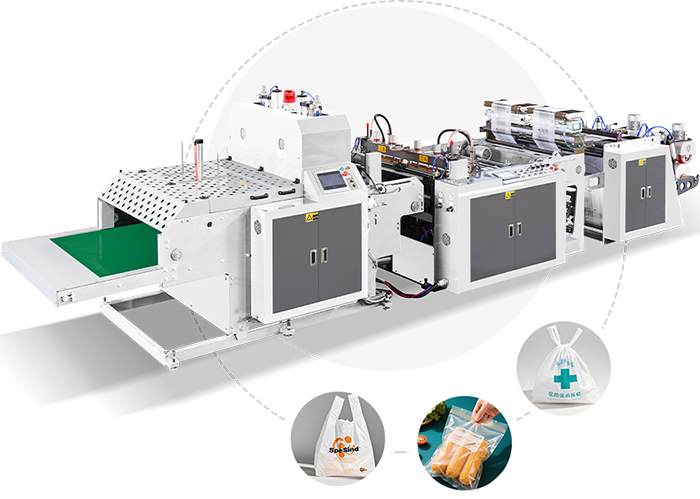
Our recommendation: CY-430×2 High-Speed Twin-Line Machine
For most medium-sized factories looking to upgrade to high-speed production, we generally recommend the CY-430×2 from Zhuxin Machinery.
This twin-line machine has a capacity of 350 pieces/min per line, for a total theoretical output of 700 bags per minute. Even applying a 70-85% discount for real-world conditions, this still translates to approximately 490-595 finished bags per minute, a significant improvement over mid-range single-line machines.
Key Features:
- Dual servomotor control system with LCD screen and programmable logic controller (PLC)
- Photoelectric cell tracking for precise sealing and cutting of printed bags
- Oscillating ejection with bag bottom forming for clean and fast stacking
- Compatible with HDPE, LDPE, and LLDPE films with a thickness of 0.010 to 0.025 mm
- Maximum bag dimensions: 400 mm wide × 650 mm long per line
- Designed for continuous 24/7 operation
The two-line configuration optimizes your factory space. You double your capacity
Contact Us
We usually get back to you within 24 hours on work days.

 English
 Español
 Pусский