You’ve just scheduled a 200,000‑bag order for a new supermarket chain. T‑shirt bags in the morning, gusseted produce bags after lunch. Your machine is rated for 200 cuts per minute – plenty fast on paper. But when you try to switch from one bag style to another, you lose half a shift. The bags come out with wavy edges, and the seals fail the pull test. Sound familiar?
I’ve watched this scene unfold in dozens of converting plants. The machine isn’t slow. It’s just not designed for quick changeovers, vibration‑free precision, or seal‑temperature stability. A plastic bag making machine that hits its brochure numbers requires three core subsystems to work together. Most buyers only discover which ones are missing after the machine is on their floor.
The “200 Cuts Per Minute” Lie That Cost You a Shift
Many suppliers quote peak speed – what the machine can do for a few minutes under ideal conditions. The real question is what happens when you change bag styles.
Where the hidden downtime lives
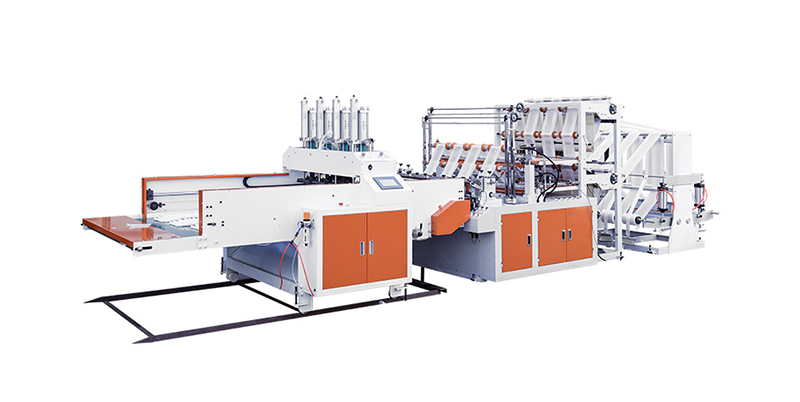
Changing from T‑shirt bags to gusseted bags or roll bags requires a different die. On conventional machines, this means loosening bolts, swapping heavy tooling, recalibrating seals, and running test cuts. Two to four hours is typical. For a plant running multiple bag styles daily, that’s a full shift of lost production every week.
What to look for: A modular die system that allows an operator to switch between bag styles in 10 minutes or less, using quick‑release clamps and pre‑set tooling. When the die is swapped, the HMI recalls saved parameters for that bag style – no manual adjustments needed.
One manufacturer has taken this further. Their laser‑polished surfaces extend die lifespan by three times compared to standard dies. The smooth finish reduces friction and wear, maintaining cut quality over years of production.
A plastic bag making machine that changes over quickly keeps your line profitable across small batch runs.
Vibration: The Invisible Enemy of Bag Consistency
You can’t feel it, but every machine vibrates. At 200 cuts per minute, even micro‑vibrations cause bag length to wander.
Why your bags come out uneven
When the cutting action vibrates the frame, the blade shifts by fractions of a millimeter. Over a thousand cycles, bag lengths can vary by several millimeters. Inconsistent bags jam automated filling lines and lead to customer complaints.
What to look for: A high‑rigidity frame that absorbs cutting forces and maintains alignment. The frame should be constructed from thick‑walled steel sections with reinforced stress points. The result is vibration‑free operation even at maximum speed, with bag dimensional tolerance kept within ±0.5%.
I’ve seen a plant where bag length variation dropped from ±2.5 mm to ±0.8 mm after upgrading to a rigid‑frame machine. That’s the difference between constant rejects and smooth production.
A plastic bag making machine with a rigid frame runs true all shift.
Temperature Drift: The Seal Failure You Can’t See Coming
Seal quality is the most visible indicator of a bag machine’s performance. Too hot, and the film scorches. Too cold, and the seal fails – bags pop open when filled.
Why your seals fail inconsistently
Basic temperature controllers drift as the machine runs. When you speed up, the heater can’t keep up; when you slow down, it overshoots. A drift of just 3‑5°C creates weak spots that fail unpredictably.
What to look for: An intelligent temperature control module that maintains sealing temperature stability within ±0.3°C using PID algorithms and high‑resolution thermocouples.
I recall a medical packaging plant where reject rates dropped from 4.7% to 0.9% after installing a precision temperature module. The same machine – same film – but stable temperature made all the difference.
A plastic bag making machine with ±0.3°C accuracy can run everything from thin undershirt bags to heavy‑duty trash bags without recalibration between runs.
Configuration Comparison at a Glance
| Configuration |
Best for |
Changeover time |
Dimensional tolerance |
Temperature stability |
Key benefit |
| T‑shirt bags |
Grocery, retail |
10 minutes (modular die) |
±0.5% at 200 cuts/min |
±0.3°C |
High output, low cost per bag |
| Gusseted bags |
Produce, bakery |
10 minutes (modular die) |
±0.5% at 200 cuts/min |
±0.3°C |
Flat bottom, better stacking |
| Roll bags |
Industrial, household |
10 minutes (modular die) |
±0.5% at 200 cuts/min |
±0.3°C |
Perforated rolls, continuous use |
| Biodegradable films |
Eco‑conscious brands |
10 minutes (modular die) |
±0.5% at 200 cuts/min |
±0.3°C (with PLA compatibility) |
Sustainable packaging |
Servo Drive: Why Mechanical Clutches Are Obsolete
Older machines use mechanical clutches and brakes. They drift over time, causing inconsistent cut lengths. Servo motors hold position exactly, cycle after cycle.
What servo precision means for your operation
-
No drift – mechanical clutches gradually lose accuracy; servos hold position exactly
-
Faster changeovers – length changes are entered on a touchscreen, not adjusted with wrenches
-
Less film waste – mis‑cuts are nearly eliminated
-
Quiet operation – servos are much quieter than pneumatic or mechanical clutch systems
The manufacturer we’re looking at uses servo drives as standard, not an expensive option. The difference? A mechanical clutch line might cost less upfront, but the total cost of ownership – including film waste and downtime – is significantly higher.
A plastic bag making machine with servo drives and a high‑rigidity frame will run true all shift.
The Hidden Value of 36 Years of Evolution
You’re probably thinking: “This sounds great, but which manufacturer actually builds machines with these features?”
A company called Zhuxin Machinery has been doing it since 1989 – more than 36 years of bag‑making expertise. Their machines are running in over 30 countries. Their plastic bag making machine has evolved through continuous improvement, incorporating feedback from thousands of installations.
Their first bag machine from the early days is still in service, a testament to build quality that most manufacturers can’t claim.
What their numbers tell you
-
30% energy saving – achieved through optimized heat sealing technology
-
200 cuts per minute – vibration‑free operation with dimensional tolerance within ±0.5%
-
10‑minute changeover – between T‑shirt bags, gusseted bags, and roll bags via modular die system
-
±0.3°C temperature stability – preventing leaks or scorching, supporting LDPE/HDPE/PP and biodegradable materials
-
36‑stage QC process – with a 99.2% first‑time installation qualification rate
Their materials lab and support
Zhuxin’s technical team includes a significant portion of engineers with over 20 years of experience. Their in‑house materials testing ensures that when you need to run a new material – say, a compostable PLA blend – they can provide a starting temperature profile and die settings based on historical data.
They also stock spare parts for all models and ship them within days. Their service team offers remote diagnostics and on‑site installation.
Compared to Alternatives – A Neutral Look
Compared to European‑built machines
European bag machines are known for precision engineering and high build quality. Lead times tend to be longer (6‑9 months is common), and pricing is typically higher. Zhuxin’s lead time is 60‑90 days for standard models, with an 18‑day fast‑track option. Both approaches have their merits – the choice depends on your timeline and budget.
Compared to lower‑priced Asian suppliers
Some Asian suppliers offer very competitive pricing. However, spare parts availability and after‑sales support can vary significantly. Zhuxin stocks spares for all models and ships them within days. This is not to say other suppliers are unreliable – only that you should verify support capabilities before ordering.
Compared to buying used equipment
Used machines can be cost‑effective, but they come with unknowns: actual hours on the gearbox, die wear, and temperature controller calibration. Zhuxin offers a 99.2% first‑time installation pass rate – a figure that reflects their quality control. A used machine might work perfectly, but you’re assuming the risk.
Common Mistakes That Cost You Thousands
Mistake1: Focusing only on cycle speed
A machine that claims 250 cuts per minute but takes 4 hours to change over delivers far fewer good bags than a machine rated 200 cuts per minute with 10‑minute changeovers. Always ask for actual production data over a full shift, not peak numbers.
Mistake2: Ignoring frame rigidity
Two machines with the same speed rating can have vastly different vibration levels. Ask for a video of the machine running at full speed. Watch the frame. If you see any wobble, walk away.
Mistake3: Not checking temperature control specs
“Digital temperature control” doesn’t mean precision control. Ask for the actual accuracy in degrees Celsius. Anything worse than ±1°C is unacceptable for consistent seals.
Mistake4: Overlooking biodegradable material support
Biodegradable resins (PLA, PBAT) have different processing windows. If you plan to run eco‑materials, verify that the temperature control system can handle the narrower range. Zhuxin’s ±0.3°C accuracy is well within the requirements for PLA.
How to Specify Your Next Bag Machine (A Cheat Sheet)
Instead of getting lost in brochures, use this checklist when talking to any supplier:
-
Changeover time – Can you switch from T‑shirt bags to gusseted bags in under 15 minutes?
-
Dimensional tolerance – What is the bag length tolerance at full speed? ±0.5% is good.
-
Temperature accuracy – What is the sealing temperature stability? ±0.3°C is excellent.
-
Frame rigidity – Is the frame designed for vibration‑free operation at your target speed?
-
Material compatibility – Can the machine run LDPE, HDPE, PP, and biodegradable resins?
-
Energy efficiency – What is the energy consumption per bag? Ask for data.
-
First‑time installation pass rate – A high rate (99.2%) indicates quality assembly.
-
Spare parts lead time – Same‑week delivery is ideal.
A Final Word From Someone Who’s Been There
I’ve visited bag‑making plants across Asia, Europe, and the Americas. I’ve seen lines that switch bag styles in ten minutes and lines that feel like they’re fighting the operator every shift. The difference almost always comes down to the three components I’ve outlined: modular die system, high‑rigidity frame, and intelligent temperature control.
You can buy a machine based on peak speed and price. Or you can buy one based on changeover time, dimensional stability, and seal consistency. The latter approach leads to lower scrap, fewer headaches, and a line that still runs when you retire.
[Image: Zhuxin factory floor with multiple bag making machines in assembly]
Ready to Stop Losing Shifts to Changeovers?
Zhuxin can provide a custom quote based on your target bag types, output requirements, and material preferences. They’ll even run a test with your film at their facility and send you the video.
【Contact Zhuxin for a custom quote】

 English
 Español
 Pусский