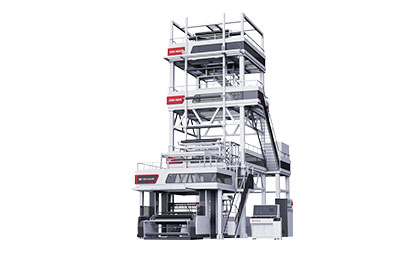
A production manager at a mid‑sized bag plant tried it last quarter. He needed to shave 8% off the raw material cost on a massive order of shopping bags. Running 50% calcium carbonate in the core of his single‑layer machine produced bags so brittle that they cracked at the grocery checkout. Then he switched his film blowing machine to ABA co‑extrusion. The outer layers remained 100% virgin LDPE, providing the bag’s tear resistance and glossy print surface. The middle layer carried 50% calcium carbonate. The finished bag felt identical to an all‑virgin bag to the customer, but the material cost per kilogram dropped by nearly 20%.
ABA co‑extrusion — two extruders feeding a three‑layer A/B/A die — is the architecture that makes this math work. The Zhuxin ABA CO‑EX AUTO film blowing machine uses a φ55 screw for the outer layers and a φ65 screw for the core, producing film at 120kg/hr for HDPE and 180kg/hr for LDPE, with a lay‑flat width of 600‑1200mm and thickness from 0.02mm to 0.10mm. This article walks through what the “AUTO” designation actually delivers on the production floor, how the symmetrical A/B/A structure differs from ABC, and the three real‑world trade‑offs every buyer should weigh before ordering a three‑layer line.
Two extruders, three layers — the ABA configuration that cuts material cost without cutting surface quality
ABA co‑extrusion uses only two extruders to produce a three‑layer film. The “A” layers — the two outer surfaces — are supplied by a single extruder, split at the die. The “B” core layer is supplied by a second extruder. This is fundamentally different from an ABC configuration, which requires three extruders and allows three different materials.
| Feature |
ABA (Two Extruders) |
ABC (Three Extruders) |
| Number of extruders |
2 |
3 |
| Die cost |
Lower |
Higher |
| Material cost reduction |
High (virgin only on surfaces) |
Very high (can use different barrier materials) |
| Changeover complexity |
Lower (two recipes vs three) |
Higher |
| Best application |
Commodity packaging where cost drives margin |
High‑barrier films, specialty constructions |
Why commodity bag converters pick ABA over ABC for faster payback
The ABA architecture is the workhorse of flexible packaging for a simple reason: most bags do not need three different materials. They need two good surfaces and a cheap middle. A shopping bag, a garbage liner, an agricultural mulch film — none of these require the barrier properties that an EVOH or nylon core provides. They do, however, require a glossy, print‑receptive outer layer and a heat‑sealable inner layer. ABA delivers both with only two extruders, reducing capital cost and simplifying operation.
Output, width, thickness — what the numbers actually deliver across a shift
The Zhuxin ABA CO‑EX AUTO film blowing machine is rated at HDPE 120kg/hr and LDPE 180kg/hr. That is not a theoretical maximum at idle; it is the sustained output when the machine is configured for ABA co‑extrusion with the die running at production temperature. The 600‑1200mm lay‑flat width range covers the most common bag widths used in T‑shirt bag production, industrial liners, and agricultural film. Thickness runs from 0.02mm to 0.10mm, which spans lightweight produce bags at the thin end to heavy‑duty shipping sacks at the thick end.
How thickness affects your daily tonnage output
The thickness range has real implications for output. Running at 0.02mm (ultra‑thin garment bags) pushes output toward the higher end of the range — 180kg/hr on LDPE. Running at 0.10mm (industrial liners) reduces throughput by roughly 30‑40% because each kilogram of film requires more heat transfer and longer cooling time in the bubble.
| Film Thickness (mm) |
Typical Application |
Approx. Output Reduction vs. Max |
| 0.02mm |
Produce bags, lightweight liners |
Minimal (near max output) |
| 0.04‑0.06mm |
T‑shirt bags, grocery sacks |
10‑15% |
| 0.08‑0.10mm |
Heavy‑duty shipping sacks, industrial liners |
30‑40% |
Why the core extruder needs a larger screw diameter
The screw diameters are φ55 for the A‑layer extruder and φ65 for the B‑layer extruder. The larger core screw is intentional — the B layer typically accounts for 50‑70% of total film thickness, depending on the A/B/A ratio set by the operator. The larger screw provides the extra melt capacity required to fill that thicker middle section without slowing down the production rate.
What the “AUTO” adds — default recipes that actually get used
The “AUTO” in the product name is not marketing decoration. The machine stores multiple production profiles in its control system. When a converter switches from a 0.04mm thick T‑shirt bag run to a 0.08mm industrial liner run, the operator recalls the stored profile. The extruder temperatures, screw speeds, air ring settings, and winding tension all reset automatically. The alternative — manually dialing in each parameter — costs 30‑45 minutes of downtime per changeover. With the automation, changeover drops to under 15 minutes.
How stored profiles reduce operator error on the night shift
The automatic profile storage matters most for converters running multiple product lines on the same machine. A plant that produces both lightweight supermarket produce bags and heavy‑duty contractor trash liners on the same line needs the ability to switch between radically different recipes without losing a half‑day of production. The AUTO system stores thickness targets, cooling parameters, and winding tension curves.
Why automatic winder tension control prevents telescoping rolls
The automation also includes automatic winder controls. The machine tracks roll diameter and adjusts tension taper automatically as the roll builds, preventing the loose film wraps that cause telescoping and ensure tight, uniform rolls that run smoothly on downstream bag‑making equipment.
.jpg)
Symmetrical A/B/A structure — why the same material on both surfaces makes better film
The ABA structure is symmetrical. The two outer layers use the same material —typically the same grade of virgin LDPE or LLDPE. Symmetry matters for film flatness and dimensional stability. An asymmetrical ABC structure, where the top layer is one material and the bottom layer is another, can curl when cooled due to differential shrinkage between the two materials. ABA film, with identical materials on both surfaces, cools uniformly, producing a flat web that tracks straight through bag machines.
How a filled B layer keeps recycling economics simple
The symmetrical triple‑layer structure enhances core barrier and strength while reducing material costs and simplifying recycling. For packaging converters targeting sustainable packaging certifications, ABA film with a recycled or calcium carbonate core is easier to recycle than an ABC structure with incompatible layers.
The upper limit for filler content without losing mechanical performance
The B layer material can be filled with recycled post‑industrial resin, post‑consumer recycled material, or calcium carbonate masterbatch at percentages up to 50% without compromising the final bag’s performance. The outer A layers, each typically 15‑25% of total thickness, provide the mechanical strength and print surface. The bag’s tear resistance, puncture resistance, and seal strength all derive from those virgin outer layers, while the core simply adds mass and stiffness.
ABA versus ABC — which one pays for itself faster in commodity packaging
| Consideration |
ABA |
ABC |
| Machine cost |
Lower (two extruders vs three) |
Higher |
| Material savings |
High (virgin only on surfaces) |
Very high (can use different cheap materials per layer) |
| Changeover time |
Shorter (two recipes vs three) |
Longer |
| Film flatness |
Excellent (symmetric) |
Can curl if layers have different shrinkage |
| Best for |
Commodity bags, agricultural film, liners |
High‑barrier food packaging, medical films |
The 18‑month payback rule for ABA machines
For a converter producing T‑shirt bags, garbage can liners, agricultural mulch film, or produce bags, the ABA configuration delivers faster payback. The lower capital cost and simpler operation mean the machine starts producing sellable film sooner. The B layer can be filled with the cheapest available feedstock — recycled LDPE pellets, calcium carbonate masterbatch, or mill‑reprocessed scrap — as long as it flows through the extruder.
When you genuinely need an ABC line instead
The ABC machine is necessary when three different functional layers are required — for example, a nylon core for gas barrier, a tie layer to bond it, and a sealant layer on the inside. That machine costs roughly 50% more than an ABA line and requires more operator training. For most flexible packaging applications, the ABC machine is over‑specified.
Where ABA film ends up — the application range that covers 80% of the flexible packaging market
ABA co‑extruded film shows up in packaging applications where cost matters as much as performance.
-
T‑shirt bags and grocery sacks — The core layer carries recycled content or calcium carbonate. The virgin outer layers provide the tear resistance and print surface for store branding. The symmetrical structure prevents curling in the bag‑making machine.
-
Garbage can liners — Heavy filler content in the B layer adds stiffness and weight, helping the bag stand open in the can. The outer layers remain flexible enough to tie closed.
-
Agricultural mulch film — The B layer can include UV stabilizers and degradation promoters. The A layers protect the additive package from leaching out while maintaining the film’s mechanical integrity during field installation.
-
Industrial liners and shipping sacks — The core layer provides bulk and puncture resistance at low cost. The outer layers take printing for product identification and handling instructions.
-
Produce bags and garment covers — When clarity matters, the B layer can use higher‑purity resin or reduced filler, while the outer layers remain the same material as the core.
How downgauging becomes possible with three layers
The strength of ABA co‑extruded film is notably higher than single‑layer film of the same total thickness. Multi‑layer structures distribute stress across the film, so a 0.05mm three‑layer bag will often out‑perform a 0.06mm single‑layer bag in puncture and tear testing, allowing converters to downgauge and reduce material consumption per bag.
Three things a production manager learned the hard way about ABA film blowing
Lesson 1: The B‑layer melt temperature is not what the setpoint claims
A production manager ran his new ABA line for two days with the B‑layer extruder temperature 15°C too low. The calcium carbonate‑filled core did not melt fully, leaving unmelted white specks visible through the transparent outer layers. The entire production run was unusable. The lesson — the B‑layer melt temperature needs independent confirmation, not just the setpoint on the controller.
Lesson 2: Screw speed readouts lie without gravimetric verification
After a maintenance shutdown, the line restarted with the A‑layer extruder feeding 20% more material than the B‑layer. The resulting film had thick outer skins but a thin, uneven core. When the film was folded into a T‑shirt bag, the bag felt rigid and crackled unnaturally. The takeaway — verify layer ratio balance with a gravimetric feeder or by measuring individual extruder outputs, not by trusting the screw speed readouts.
Lesson 3: Tension curves from a mono‑layer line do not work on ABA film
A converter switched from a single‑layer line to ABA but kept the same winding tension taper values. The ABA film, with its stiffer core, needed a different tension profile. The rolls developed telescoping during storage, and the bag machine had constant registration issues. The fix — retune the winder tension curves for each ABA recipe and store them in the machine’s auto profiles.
How the ABA CO‑EX AUTO film blowing machine fits into a packaging converter’s floor
Zhuxin Machinery has built blown film extrusion lines since 1989, with more than 2,000 successful installations worldwide. The ABA CO‑EX AUTO platform is their automated co‑extrusion solution for converters transitioning from single‑layer to multi‑layer production.
The machine is supplied with a co‑extrusion die sized for the target film width, an air ring for bubble cooling, a collapsing frame with nip rollers, and an automatic surface winder. The German‑standard precision transmission system and energy‑efficient drive package reduce power consumption significantly compared to older designs. All three extruders — two φ55 and one φ65 — are equipped with frequency converters for individual speed control, and the L/D ratio is 30:1 for complete melting of recycled feedstocks.
For a film blowing machine that puts recycled material where it belongs — hidden between two layers of virgin resin without showing up in surface defects — the ABA CO‑EX AUTO platform delivers the material cost savings that commodity packaging demands, with the automation that keeps changeover time short and operator intervention minimal.
【Request a quote from Zhuxin Machinery】

 English
 Español
 Pусский