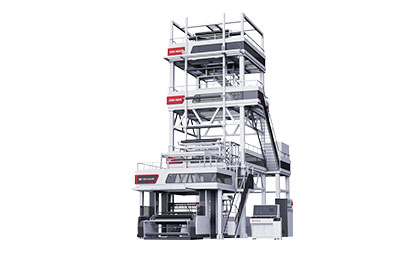
A bag converter in Vietnam needed to produce 30 tons of 0.04mm HDPE garbage bags per week. Their existing mono‑layer extruder ran at 80kg/h, and they were considering a second shift just to meet demand. The upgrade was not to a co‑extrusion line with multiple screws. The upgrade was to a larger single screw blown film machine, with a φ100 extruder running at 150‑200kg/h, producing a 1200‑2000mm wide bubble in one pass.
A film blowing machine configured for garbage bags is not fundamentally different from a general‑purpose mono‑layer extruder. It has one screw, one barrel, one melt stream. The difference is in the scale: a larger screw diameter (φ100), a longer barrel (30:1 L/D ratio), a wider die (matched to 2000mm lay‑flat), and a cooling system sized for high output. The film emerges at 0.03‑0.20mm thickness — thin enough for shopping bags, thick enough for heavy‑duty industrial liners.
This article explains how a single screw blown film line processes garbage bag film, why the φ100 screw and 30:1 L/D combination delivers 150‑200kg/h, and which output parameters determine whether a machine can keep a bag‑making line fed.
What Defines a Garbage Bag Film Blowing Line?
A dedicated garbage bag blown film line is optimized for one thing: high output of commodity film. It does not need multiple extruders for co‑extrusion. It does not need complex die heads for layer distribution. It needs consistent melt, stable bubble, and fast cooling.
The single screw film blowing machine for garbage bag production from Zhuxin is designed around a φ100 screw with a 30:1 L/D ratio. The barrel has multiple heating zones, and the melt temperature is controlled by German‑standard temperature modules, maintaining ±0.5°C accuracy across the length of the barrel. The screw itself is a self‑developed high‑precision barrier screw, optimised to plasticise HDPE, LDPE, and LLDPE without unmelted gel particles that would create weak spots in the bag. The screw and barrel are made from nitrided 38CrMoAlA steel, a material grade that resists wear when processing recycled resin — which most garbage bag converters use in their core layer [5†L65].
The machine includes a German‑imported gearbox that synchronises haul‑off and rewinding, reducing film breakage risk and maintaining finished product flatness to within ±2% tolerance. For a bag‑making line, a film with poor flatness will cause the bag maker to jam; the ±2% spec ensures that the film runs straight through the downstream equipment.
| Parameter |
Value |
| Film width |
1200‑2000 mm |
| Film thickness |
0.03‑0.20 mm |
| Max output (HD) |
150 kg/h |
| Max output (LD) |
200 kg/h |
| Screw diameter |
φ100 mm |
| Screw L/D ratio |
30:1 |
| Suitable resins |
HDPE, LDPE, LLDPE |
Data sourced from Zhuxin product specifications.
The output range covers 150kg/h for HDPE (which is stiffer and requires more torque) and 200kg/h for LDPE (which flows more easily). At 200kg/h, a single shift produces 1.6 tons of film — enough for roughly 160,000 shopping bags at 10 grams per bag.
Why the Width Range Determines Your Downstream Slitting Strategy
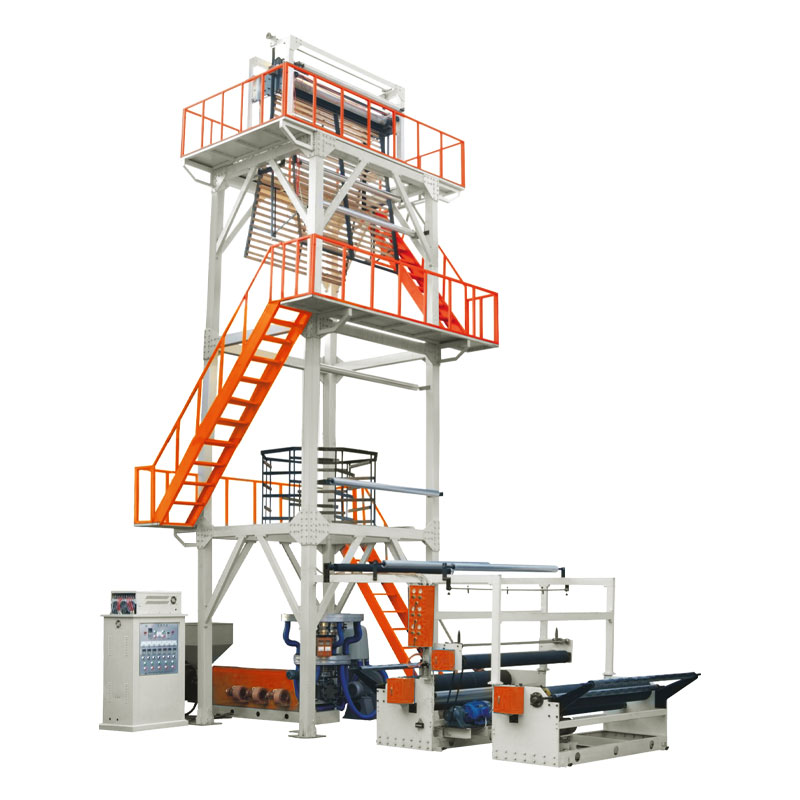
A film blowing machine with a 2000mm maximum width can produce a bubble that, when collapsed, yields a lay‑flat width of 2000mm. That is the width before slitting. A bag converter will slit that wide roll into narrower rolls to feed multiple bag‑making lines.
The 1200‑2000mm range gives the converter flexibility. A plant running four bag‑making lines each requiring 500mm wide rolls can set the slitting knives to cut the 2000mm web into four 500mm lanes. A plant running two lines requiring 600mm rolls can cut the web accordingly. The leftover edge trim — typically 5‑10mm per side — is recycled back to the extruder via a granulator. For a plant processing 1,000 tons of film per year, that edge trim return reduces material cost by 3‑5%.
The collapsed bubble is passed through a set of nip rollers and then wound onto a surface winder. The winder includes a lay‑on roller that applies constant pressure as the roll diameter increases, preventing telescoping — the edge misalignment that makes rolls unuseable on bag‑making machines.
Output Speed and Thickness: The Two Numbers That Define a Shift‘s Production
A bag converter‘s daily output is not determined by the extruder‘s peak kg/h alone. It is determined by the combination of output (kg/h) and film thickness (mm). Thinner film uses less material per square metre, so the same kg/h produces more linear metres. Thicker film uses more material, so the linear output drops.
At 200 kg/h producing 0.03mm LDPE film, the line outputs approximately 6,670 linear metres per hour. At 150 kg/h producing 0.10mm HDPE film, the line outputs approximately 1,500 linear metres per hour. The operator must match the extruder output to the bag maker‘s consumption. A bag maker running at 300 bags per minute with a 500mm bag length consumes 150 metres of film per minute, or 9,000 metres per hour. The blown film line must supply at least that rate.
For a typical garbage bag plant with two bag‑making lines, the φ100 blown film line running at 150‑200 kg/h is sized to feed both lines simultaneously, with a buffer roll in‑between. The film rolls are slit to width and wound onto cores that fit directly onto the bag maker‘s unwind stand.
Why the 30:1 L/D Ratio Matters for Bag Film
A shorter screw (24:1 or 26:1) would leave unmelted gel particles in the melt. Those particles appear as translucent spots in the finished film — weak points that tear when the bag is filled. The 30:1 ratio provides additional mixing length, ensuring that even recycled resin with varying melt flow indices is fully homogenised before exiting the die. The screw also has a barrier flight section that separates the melt from the solids, preventing unmelted chunks from reaching the die lip. For a bag converter running 50% recycled content in the core layer (when using a co‑extrusion line) or 100% virgin for thin‑wall bags, the longer screw is the margin of safety against gel defects.
HDPE vs LDPE: Why the Same Machine Outputs Different Rates
The machine‘s maximum output is listed as 150kg/h for HDPE and 200kg/h for LDPE. The difference is not arbitrary. HDPE has a higher density (0.94‑0.96 g/cm³) and a narrower molecular weight distribution, which makes it stiffer and more shear‑sensitive. LDPE is less dense (0.91‑0.93 g/cm³) and melts at a lower temperature, flowing more easily through the die.
For a bag converter running HDPE for stiff, crinkly T‑shirt bags, the 150kg/h output is sufficient for most bag‑making lines. For LDPE run for soft, stretchy garbage can liners, the 200kg/h output provides a higher linear metre rate.
The machine handles blends as well — a 70/30 blend of HDPE and LLDPE produces a bag with the stiffness of HDPE and the tear resistance of LLDPE. The operator sets the extruder temperature profile based on the blend ratio, stored in the PLC recipe.
Cooling and Bubble Stability: Where Gauge Consistency Comes From
A film blowing machine running at 200 kg/h must cool the bubble quickly enough to freeze the film before it collapses under its own weight. The machine uses an air ring with adjustable air volume; the primary air jet immediately freezes the melt surface as it exits the die, and the secondary airflow maintains bubble diameter. The cooling air is directed by a wind‑gathering skirt that prevents ambient drafts from disturbing the bubble.
The bubble‘s frost line — the height at which the film transitions from molten to solid — is visible to the operator. A low frost line indicates that the cooling air is too aggressive, causing the film to freeze before the bubble has fully expanded. A high frost line indicates insufficient cooling, which makes the bubble unstable and prone to gauge variation.
The machine is equipped with a German‑imported gearbox that synchronises the haul‑off speed with the extruder output. If the haul‑off pulls too fast, the film stretches and thins; if too slow, the film is thicker than spec and the bag converter pays for excess material. The gearbox maintains constant speed with less than ±2% variation, ensuring that the film gauge stays within tolerance across the entire roll [5†L65].
For a bag converter running a bag‑making line that prints registration marks, gauge variation of even 3‑5% can cause the printing to drift out of register. The ±2% tolerance keeps the printer running without constant adjustment.
What Materials Can You Run?
The single screw blown film machine processes the three main polyolefins used in garbage bag production.
HDPE (High‑Density Polyethylene) – Produces stiff, crinkly film for T‑shirt shopping bags and lightweight trash liners. The machine runs HDPE at up to 150 kg/h, producing film down to 0.03mm.
LDPE (Low‑Density Polyethylene) – Produces soft, stretchy film for can liners and industrial sacks. The machine runs LDPE at up to 200 kg/h, producing film up to 0.20mm.
LLDPE (Linear Low‑Density Polyethylene) – Used in blends to improve tear resistance and puncture strength. The machine processes LLDPE blends without modification.
The machine can also process recycled LDPE pellets, though the output may drop by 10‑20% depending on the contamination level and melt flow consistency. For a bag converter looking to reduce material cost, the ability to run post‑industrial recycled resin in the film — even in a mono‑layer line — is a significant advantage.
How to Match the Machine to Your Bag‑Making Capacity
Before specifying a blown film line, calculate your bag maker‘s consumption. A bag‑making machine running at 300 cuts per minute with a 500mm bag length consumes 150 metres of film per minute, or 9,000 metres per hour. Multiply by the film thickness in metres and by the film density to get the required kg/h.
For a 0.04mm HDPE bag (density 0.96 g/cm³), 9,000 metres per hour of 500mm wide film consumes roughly 173 kg/h. That is above the 150 kg/h output of the φ100 line. The bag converter would need a second blown film line to feed the bag maker, or they would accept that the bag maker runs at a lower speed. For a 0.03mm LDPE bag (density 0.92 g/cm³), the same bag maker consumes roughly 124 kg/h — well within the 200 kg/h output.
The practical lesson: a converter running thin LDPE bags can feed a fast bag maker with one blown film line. A converter running thick HDPE bags needs either a slower bag maker or a second blown film line.
Frequently Asked Questions About Garbage Bag Film Blowing Machines
Can the same machine produce both shopping bags and heavy‑duty industrial sacks?
Yes, within the thickness range of 0.03‑0.20mm. The operator adjusts the haul‑off speed and the extruder output. For heavy‑duty sacks at 0.15‑0.20mm, the line runs slower (around 100‑120 kg/h) but still produces film that meets the strength requirements. The bubble cooling must be increased for thicker film, as the greater mass takes longer to solidify.
How often does the screen pack need to be changed?
When running virgin resin, the screen pack may last 2‑3 weeks. When running recycled resin with higher contamination, the screen pack may need changing daily. The machine is equipped with a hydraulic screen changer that allows the operator to change screens without stopping the extruder, taking less than 30 seconds.
What is the typical energy consumption of a φ100 blown film line?
The main drive motor is typically 75‑90 kW. The barrel heaters consume additional power during startup but cycle on and off once the line reaches operating temperature. A typical 200 kg/h line running LDPE consumes about 0.4‑0.5 kWh per kg of output. At 0.10perkWh,theenergycostpertonis0.10perkWh,theenergycostpertonis40‑50 — a small fraction of the resin cost.
Can the machine produce biodegradable film?
Yes, the machine processes PLA and PBAT‑based biodegradable resins. The temperature profile must be adjusted downward (PLA melts at 150‑170°C vs 180‑210°C for LDPE), and the cooling air must be increased because biodegradable resins have lower melt strength. The φ100 screw is suitable for biodegradable material with the correct temperature settings.
How the Single Screw Film Blowing Machine Fits into a Bag Converter‘s Production Line
Zhuxin Machinery has focused on blown film technology for over 36 years, evolving from local innovation to globally certified (CE/TÜV) energy‑efficient solutions serving 50+ countries [5†L65]. The single screw film blowing machine for garbage bag production is built around a φ100 screw with a 30:1 L/D ratio, a German‑standard gearbox, and German‑imported temperature control modules that maintain ±0.5°C accuracy across all heating zones [5†L65].
The machine delivers 1200‑2000mm film width, 0.03‑0.20mm thickness, 150‑200 kg/h output, and is suitable for HDPE, LDPE, and LLDPE. It includes a hydraulic screen changer, a dual‑lip air ring, a German‑standard gearbox, and a surface winder with lay‑on roller. The screw and barrel are made from nitrided 38CrMoAlA steel, and the machine is equipped with a Siemens PLC with a touch screen HMI for storing job recipes.
A film blowing machine that runs 150‑200 kg/h of 0.03‑0.20mm film, with a 2000mm width, keeps a high‑speed bag‑making line supplied. For a bag converter who needs to produce shopping bags in the morning and industrial liners after lunch, the single screw line with φ100 extruder delivers the output range, width flexibility, and material compatibility that a high‑volume plant requires.
[Request a quote from Zhuxin Machinery]
Contact Zhuxin with your target film width (1200‑2000mm), material type (HDPE, LDPE, or LLDPE), and daily output requirement to receive a machine configuration recommendation and a production rate calculation for your bag‑making line.

 English
 Español
 Pусский