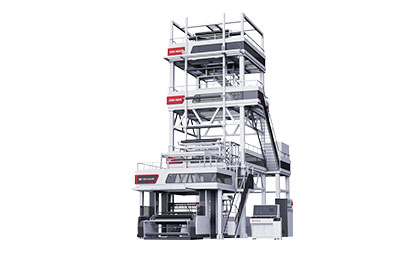
Let me tell you about two blown film lines I’ve seen. One, a 1988 model, still runs daily and holds gauge within spec. The other, bought just five years ago, drifts so badly that operators adjust temperature every hour. Same resin, same output target – completely different outcomes. What separates them? Three components that most buyers overlook until it’s too late. A film blowing machine that earns its keep over decades isn’t about max output numbers. It’s about the screw, the temperature control that holds ±0.5°C, and the gearbox that keeps haul‑off and rewinding perfectly synced. This guide walks through each of those parts, using real data from a manufacturer that has been refining them since 1989
Three Components That Make or Break Your Film Quality
Every blown film line has an extruder, a die, a cooling system, haul‑off rollers, and a winder. But the quality of the output depends on three specific parts. Miss one, and the rest doesn’t matter.
The screw – where crystal points start or stop
A poorly designed screw leaves unmelted particles – crystal points – that ruin optical clarity and create weak spots. Generic screws work fine for virgin LDPE, but the moment you add recycled material, color masterbatch, or biodegradable resins, they choke.
What to look for: a self‑developed high‑precision screw that optimises plasticising uniformity, eliminates crystal points and thickness fluctuations, and guarantees consistent tensile strength and light transmission. One manufacturer’s lab has tested over 6,800 formulations, building a database that lets them match a screw profile to your specific material basket – not guess.
Temperature control – the hidden driver of seal strength
A drift of just 3‑5°C can cause embrittlement, poor heat seals, or visible defects. For food‑grade or medical film, that margin will destroy your seal integrity.
What to look for: a German ±0.5°C temperature control module that stabilises melt fluidity, avoids poor heat sealing and embrittlement, and meets food‑grade and medical certification standards. This isn’t a luxury – it’s a requirement if you want to pass audits and avoid recalls.
Gearbox – the part nobody thinks about until it breaks
When the haul‑off and winder fall out of sync, you get telescoped rolls, wrinkled edges, and uneven tension that leads to breakage on the bag machine.
What to look for: a German‑imported gearbox that maintains constant speed synchronisation between haul‑off and rewinding, reducing film breakage and keeping finished roll flatness within ±2% tolerance. Cheap gearboxes drift. Over an 8‑hour shift, a 2% speed variation translates to meters of wasted film.
A film blowing machine that gets these three components right will pay you back shift after shift.
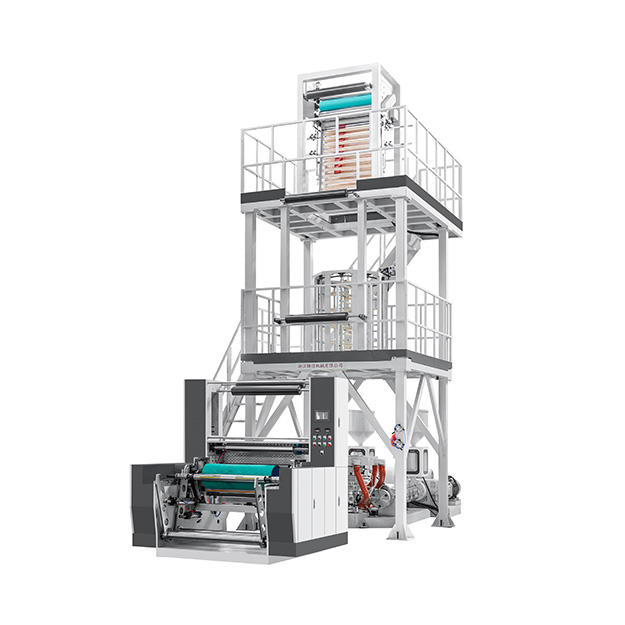
From Mono‑Layer to Five‑Layer – What One Platform Can Do
Not every line needs five layers. But having options matters. Zhuxin offers configurations that cover the full range.
| Configuration |
Best for |
Key benefit |
| Mono‑layer |
Commodity film (garbage bags, shopping bags) |
Lowest cost per kg, 18% energy saving |
| AB two‑layer |
Food composite packaging |
Peel strength +30% |
| ABA three‑layer |
Daily chemical, agricultural film |
Center layer material -40%, tear strength +50% |
| ABC three‑layer |
High‑barrier structures |
Haze ≤3% |
| Five‑layer |
Premium food, medical, pharma |
Raw material cost -15%+, layer uniformity ≤3% |
A film blowing machine that can switch between these configurations without rebuilding the line gives you flexibility to serve multiple markets.
Where the 80% Energy Saving Comes From
Zhuxin claims up to 80% energy savings compared to conventional models. That number comes from three specific engineering choices.
German‑standard precision transmission system
The drive train uses a German‑standard precision transmission system that reduces mechanical losses. Less energy turns into heat; more turns into film.
PID temperature control with minimal overshoot
Instead of heaters running at full power then shutting off, PID controllers modulate to maintain exact temperature. This reduces energy waste and prevents degradation.
Five‑roller traction
Most blown film lines use three or four haul‑off rollers. Five‑roller traction keeps film flatter and tension more consistent, allowing you to run at higher speeds with the same energy input.
Why 36 Years of Experience Isn’t Just a Number
Zhuxin has been building blown film machines since 1989. That’s 36 years of refinements, not a startup with a good marketing team.
Materials laboratory
Their lab has tested over 6,800 raw material formulations, storing more than 150 terabytes of process data. When you need to run a new material – say, a compostable PLA blend – they don’t guess. They pull up a screw profile and temperature settings that have already been validated.
Senior technicians
35% of their technical backbone have more than 20 years of experience. When a customer hits a problem, their response speed is 70% faster than industry average.
Living history – a machine still running
The first batch of blown film machines produced in 1988 – a model ZX‑100 – is still running today. It has accumulated more than 260,000 trouble‑free hours and produced over 800 million square meters of film. That’s not a lab test; it’s field‑proven data.
Production Capacity and Quality Control
Small manufacturers choke on big orders. Zhuxin’s scale eliminates that risk.
-
200+ units per month with 40% higher scalability
-
18‑day fast‑track service for urgent orders
-
36‑stage QC process with a 99.2% first‑time installation qualification rate
90% of core components are self‑developed, not outsourced. That means when a screw or gearbox needs replacement, they don’t wait weeks for a third‑party supplier.
Ask for a spec sheet made for your material
You don't need a generic brochure. Zhuxin will send you screw configurations, winding options, and energy data tailored to your film type and output target.
A film blowing machine built with a self‑developed screw, German temperature control, a German‑imported gearbox, and 36 years of evolution is a long‑term asset.
【Request a custom spec sheet】

 English
 Español
 Pусский