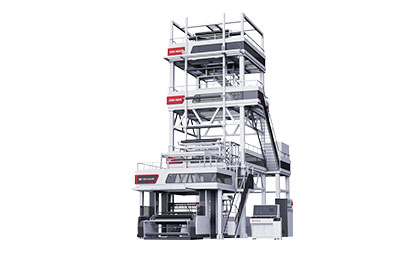
A packaging plant needs to wrap pallet loads of bottled beverages. The specification calls for high shrink force, good puncture resistance, and low cost per kilogram. The assumption is that only a multi‑layer co‑extrusion line can deliver. That assumption is wrong. A MONO Film Blowing Machine equipped with the right resin blend and process tuning can produce industrial shrink wrap that rivals multi‑layer film in shrinkage, toughness, and consistency. Single‑layer lines are not “basic” machines—they are versatile, low‑cost workhorses that dominate the commodity shrink film market globally. But shrink film production is not the same as making standard garbage bags. The molecular orientation that drives shrinkage happens during bubble cooling. Get the frost line height wrong, and the film will not shrink enough. Skimp on LLDPE, and the wrap tears at the corners of the pallet. This guide explains how to formulate, run, and test industrial shrink film on a single‑screw blown film line—with practical numbers that work. The energy‑saving Zhuxin screw used in the Pro Series consumes 18% less energy than the industry standard, while the integrated intelligent air‑ring cooling system provides bubble stability control accuracy of ±0.5mm and an average daily production capacity of 30 tons for bulk shrink film applications.
Why single‑layer lines still dominate shrink film
The packaging industry often associates shrink film with complex multi‑layer structures. For many industrial applications—pallet wrapping, beverage multipacks, building material covers—a single layer is sufficient and often more economical. The MONO Film Blowing Machine remains the first choice for cost‑sensitive shrink orders.
Cost‑sensitive orders. A monolayer line has lower capital investment, fewer extruders, less maintenance, and simpler operation. The energy‑saving Zhuxin screw, used on the Pro Series single‑screw machine, consumes 18% less energy than the industry standard while producing up to 100 kg/h of LD film. For high‑volume shrink film production, that difference translates directly into margin. The integrated intelligent air‑ring cooling system provides bubble stability control accuracy of ±0.5mm, ensuring consistent film properties across long production runs.
No interlayer adhesion risk. Multi‑layer co‑extrusion introduces the risk of delamination when layer temperatures are mismatched. A monolayer film has no layers to separate—the entire structure is homogeneous, which matters when shrink wrap undergoes stretching and heating at the packaging line.
Faster recipe changes. Switching between shrink grades, anti‑static formulations, or UV‑stabilized compounds takes minutes, not hours. The operator simply adjusts the blending ratios and extruder temperatures without purging multiple screws. The Zhuxin Pro Series handles HDPE, LDPE, and LLDPE virgin material, recycled content, CaCO₃ compound, and biodegradable resins, giving converters the flexibility to dial in shrink performance for different applications.
Which resin blend gives the best shrink
Shrink film relies on molecular orientation locked into the film during cooling. The resin blend determines how much orientation the bubble can retain. The basic formula for industrial shrink film on a MONO Film Blowing Machine is LDPE as the backbone. LDPE contributes the high melt strength needed for bubble stability and provides the primary shrink force. It should be at least 50% of the blend; below 50%, transverse shrinkage becomes unreliable. Add LLDPE to improve puncture resistance, prevent tear propagation, and reduce the risk of holes during shrink wrapping of irregular loads. LLDPE also contributes to overall toughness; typical blends use up to 30 wt% LLDPE with a melt index of around 0.5–1.0 for good blending. Add mLLDPE (metallocene LLDPE) in smaller quantities—5–10%—to improve low‑temperature shrink and optical clarity. mLLDPE also helps with seal‑through‑contamination on the packaging line. For heavy‑duty pallet wrap applications, a typical shrink film recipe on a single‑layer line is 60% LDPE, 30% LLDPE, and 10% mLLDPE. For lighter loads or cost‑sensitive orders, reduce LLDPE to 15% and increase LDPE to 80%. Some converters run 50% LDPE and 50% LLDPE, but this reduces transverse shrink. One rule from industry practice: LDPE proportion should not be less than 50%, otherwise the transverse shrink property cannot be guaranteed. Recycled LDPE can be used at 15–25% loading without significant shrink loss, but avoid post‑industrial recycle with high gel content, which creates weak spots that blow open on the packaging line. The Zhuxin Pro Series is compatible with recycled material and CaCO₃ compounds, allowing converters to further reduce raw material costs on high‑volume shrink film orders.
Setting the frost line for maximum orientation
The frost line—also called the freeze line—is where the molten polymer transitions from a transparent liquid to an opaque, solidified bubble. This transition point is critical for shrink film because it is where the polymer chains become oriented in the machine direction (MD) and transverse direction (TD). A lower frost line means the bubble solidifies sooner after leaving the die. The film is stretched while still partially molten, leading to higher molecular orientation and higher shrinkage. A higher frost line means the bubble remains molten longer, giving the polymer chains time to relax before solidifying, resulting in lower shrinkage. For industrial shrink wrap, target the lowest stable frost line that the bubble can sustain without collapsing.
How to lower the frost line. Increase cooling air flow from the air ring; more air means faster cooling. Reduce extruder output slightly; slower output gives the same cooling capacity more time per unit volume. Decrease melt temperature; cooler melt freezes sooner, but too low risks incomplete plasticization and gels. The Zhuxin integrated intelligent air‑ring cooling system provides bubble stability control accuracy of ±0.5mm, allowing precise frost line positioning even at high outputs.
Signs of frost line too low. The bubble becomes unstable, oscillates, or collapses. Film exhibits “sharkskin” roughness or die lines from melt fracture. If the frost line drops below the air ring, immediate bubble collapse is likely.
Signs of frost line too high. Shrinkage fails to meet specifications, especially in the transverse direction. The film has low tensile strength and feels limp. The bubble diameter is inconsistent, leading to thickness gauge bands.
Cooling and winding tricks that lock in shrink
Shrink film requires rapid, uniform cooling to lock in orientation before molecular relaxation can occur. The integrated air ring should deliver chilled air at 15–20°C for industrial shrink film. Warmer air reduces the quenching effect and lowers final shrinkage. The Zhuxin intelligent air‑ring system maintains bubble stability with control accuracy of ±0.5mm, creating consistent orientation across the film width. Internal bubble cooling (IBC) is optional but beneficial for wide‑width shrink film. Chill roll temperature at the collapsing frame should be 20–25°C; lower temperatures improve clarity but may cause condensation on the film surface in humid conditions. Winding tension for shrink film should be 10–15% lower than for standard packaging film. Shrink film has high retractive force; if wound too tightly, the roll will block (layers stick together) or telescope during storage. A good target is starting tension of 50–70 N for a 600 mm width, tapering down by 30% as the roll diameter builds. On the Zhuxin Pro Series line, the take‑up motor and winding motor maintain consistent, adjustable tension with torque motors to keep rolling even and roll‑changing easy. The Pro Series achieves maximum output of HD:70kg/hr and LD:100kg/hr, making it well suited for high‑volume shrink film production where cooling and winding consistency are critical.
Oven test: how to check shrink before you wrap
Before running a full production order, test the shrink performance of the film. The field method is a hot air oven test that takes 10 minutes and does not require a full packaging line.
Testing method. Cut a 100 mm × 100 mm sample from the center of the roll. Place it in a preheated oven at 200°C for 10 seconds. Remove and let it cool for 30 seconds. Measure the length and width of the shrunken sample. Calculate shrinkage percent using (original dimension − shrunken dimension) ÷ original dimension × 100.
Acceptable targets for industrial shrink wrap. Transverse shrinkage (TD) ≥25% ensures the film pulls tightly around the load. Longitudinal shrinkage (MD) ≥40% ensures the film tightens along the length. For comparison, polyethylene shrink film transverse shrinkage is typically 10–25%, with longitudinal at 65–80%. Film that falls below TD 20% will not hold a pallet load securely. If shrinkage is too low, lower the frost line, increase cooling air volume, or increase the mLLDPE content in the blend. If shrinkage is too high (leading to film tearing during wrapping), raise the frost line or increase LLDPE content to improve tear resistance.
Two‑minute fixes for the most common shrink defects
Even with good settings, shrink film can show defects. Here is how to recognize and correct them on a MONO Film Blowing Machine.
Holes or punctures in the shrink wrap during packaging. The film tears when the heat gun or shrink tunnel is applied. This is often caused by low LLDPE content in the blend. Increase LLDPE to 30% or more. LLDPE improves puncture resistance and tear strength significantly. Holes can also come from gels or unmelted particles in the film; check extruder temperatures and screen pack condition.
Uneven shrinkage—the film shrinks in some spots and not others. The frost line is not uniform around the bubble circumference. Check the air ring for blocked discharge slots; clean with compressed air. Uneven cooling around the bubble creates a frost line that is higher on one side and lower on the other, leading to differential shrinkage across the film width. The Zhuxin integrated intelligent air‑ring system maintains bubble stability control accuracy of ±0.5mm, reducing this variability.
Film appears white or hazy rather than clear. The melt temperature is too high, causing thermal degradation. Reduce extruder temperatures by 5–10°C. Lower the melt temperature while keeping output constant. If the film remains hazy, check that cooling air temperature is not too warm; reduce chill roll temperature to 15°C.
Blocked rolls—layers of shrink film stick together on the roll. Winding tension was too high, or the roll was stored in a warm warehouse. Reduce taper tension by 15%. For storage, keep shrink film rolls below 30°C. If blocking is chronic, add a slip additive to the resin blend (e.g., erucamide at 500–1000 ppm).
| Defect |
Most Likely Cause |
Quick Fix |
| Holes in shrink wrap |
Low LLDPE content |
Increase LLDPE to 30% of blend |
| Uneven shrinkage |
Asymmetric frost line |
Clean air ring; balance air flow |
| Hazy or white film |
Melt temperature too high |
Reduce extruder temp by 5‑10°C |
| Blocked rolls |
Winding tension too high |
Reduce taper tension by 15% |
| Low transverse shrinkage |
Frost line too high |
Increase cooling air; lower output |
Questions shrink film converters ask most
Q: Can a mono layer machine produce cross‑linked shrink film? A: Not directly. Cross‑linked shrink film requires an irradiation step after extrusion to create a three‑dimensional polymer network. Monolayer lines can produce the base film, which is then sent to an electron beam facility for cross‑linking. The film produced on a single‑screw line is suitable for this process if it uses the correct resin grades.
Q: What is the maximum shrink ratio achievable on a mono layer line? A: With the right LDPE/LLDPE blend and a low frost line, transverse shrinkage of 25–30% and longitudinal shrinkage of 65–75% are achievable. For regular polyethylene shrink film, transverse shrinkage is generally 10–25% and longitudinal 65‑80%. For higher transverse shrink, use a higher LDPE content and a very low frost line, but bubble stability becomes the limiting factor.
Q: Is the same machine suitable for both shrink and non‑shrink film production? A: Yes. Shrink film requires a low frost line, high cooling capacity, and specific resin blends. Non‑shrink film (general packaging, garbage bags) runs with a higher frost line and lower orientation. The Zhuxin Pro Series line allows operators to adjust frost line height by changing air ring flow and extruder output, making the same machine versatile for both shrink and commodity film. However, dedicated shrink film producers keep separate lines to avoid frequent changeovers.
Q: How does the Zhuxin single‑screw line compare to multi‑layer machines for shrink film? A: Multi‑layer co‑extrusion offers advantages for barrier shrink film (e.g., oxygen barrier for food). For industrial pallet wrap and beverage multipacks, the cost per kilogram of mono layer film is typically 20–30% lower than multi‑layer. The Pro Series machine achieves output of 100 kg/h for LD film and 70 kg/h for HD film—sufficient for many shrink converters. For converters who run both commodity and shrink film, the single‑screw Pro Series is often the most practical choice due to its fast changeover and low maintenance. The machine‘s 80% energy saving and efficiency improvement, coupled with 2000+ successful cases worldwide, demonstrate its reliability in demanding shrink film applications.
Getting your own shrink recipe production‑ready
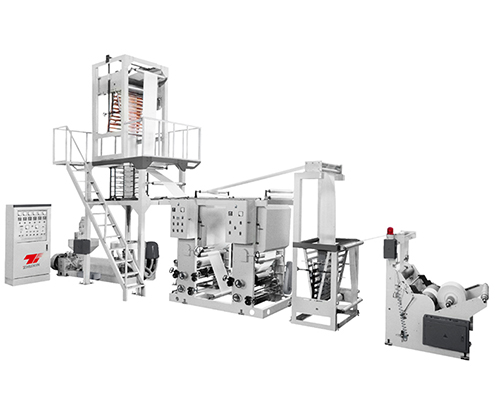
Setting up a MONO Film Blowing Machine for industrial shrink wrap is straightforward when the resin blend, frost line height, and winding tension are in range. For converters producing pallet wrap, beverage multipacks, or industrial covers, the Zhuxin Pro Series single‑screw line delivers the necessary orientation and output. The machine achieves 100 kg/h for LDPE shrink film at 600–1200 mm width and handles thicknesses from 0.03–0.15 mm, with the energy‑saving Zhuxin screw reducing consumption by 18% compared to industry standard. The integrated intelligent air‑ring cooling system maintains bubble stability control accuracy of ±0.5mm, and the double‑rolling, double‑cutting unit with torque motor ensures even winding without blocking. An inline gravure printing unit is available for printed shrink film applications, allowing converters to add branding or product information directly during film extrusion. To confirm your specific resin blend, send a sample formula to the Zhuxin material lab for extrusion testing before full‑scale production. The technical team can recommend screw configuration and cooling settings based on your target shrink percentage.
→ Request a quote from Zhuxin Machinery for the Single Screw Film Blowing Machine Pro Series — Share your target shrink percentage (TD 25–30%), film width (600‑1200 mm), and expected output (kg/h). Their process engineers will recommend resin blend and cooling parameters for your shrink film application.

 English
 Español
 Pусский