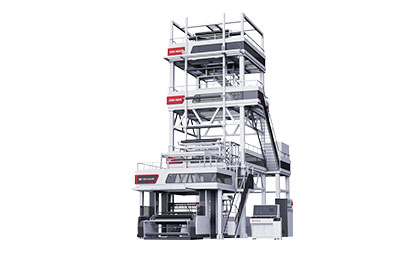
You want a film that seals easily, blocks oxygen, and resists scratches. One material can’t do all three. So you combine them – a heat‑sealable inner layer, a high‑barrier middle layer, and a tough outer layer. That’s the promise of three‑layer co‑extrusion. But getting those layers to bond without mixing, and keeping the film crystal clear, takes more than just stacking extruders. A film blowing machine designed for ABC structures has to handle three different melt temperatures, synchronize three screws, and spin the die to hide thickness variations. This guide walks through the hardware that actually makes a difference – from the screw that melts each resin uniformly to the gearbox that keeps tension steady.
You’re Not Asking for a Mono‑Layer Line
Mono‑layer film is fine for garbage bags. Not for vacuum‑packed cheese or a medical sterile barrier. By the time you’re reading about ABC machines, you already know that.
The question isn’t “do I need three layers?” It’s “which three layers, and how do I keep them from delaminating?”
The A, B, and C
-
A (outer): Takes the abuse – scratches, UV, printing inks.
-
B (core): Does the heavy lifting on barrier – oxygen, moisture, aroma.
-
C (inner): Seals cleanly and safely, often at lower temperatures.
Each layer feeds from a separate extruder. They meet at the die and flow together without mixing. That’s the magic of co‑extrusion – and the point where most problems start.
A film blowing machine (second mention) that can’t hold temperature within half a degree will leave you with a seal that fails at the grocery store.
The Die That Spins (And Why You Should Care)
Most film dies are stationary. They produce a “machine direction” orientation that can make film look streaky or wavy.
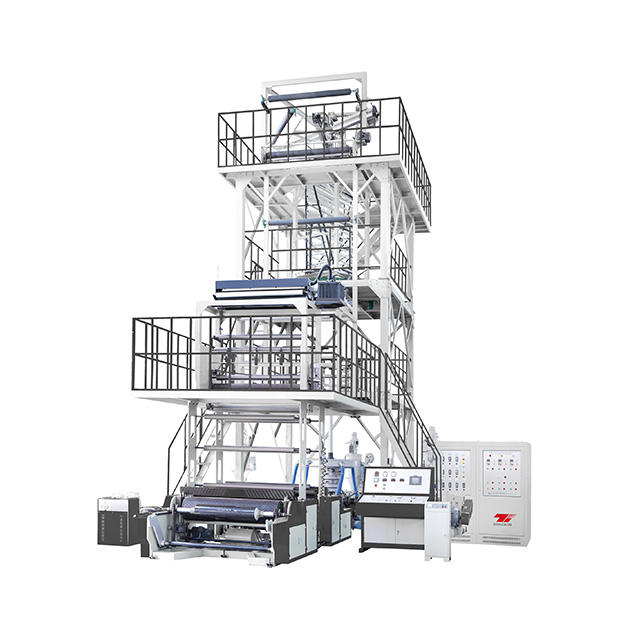
Zhuxin’s rotary die head rotates during production. The movement averages out thickness variations across the web. The result: haze drops to 3% or less. That’s crystal clear.
What ≤3% haze means
Premium cheese, fresh meat, medical devices – customers want to see what’s inside. A cloudy film hides the product; a clear film sells itself.
Optional in‑line surface treatment prepares the film for printing or coating without an extra pass.
Three Parts That Won’t Show Up on a Price Quote (But Should)
You’ll see “35:1 screw” and “150 kg/h” in every brochure. Here’s what they don’t emphasize.
The screw – self‑developed matters
A generic screw might melt LDPE fine. Add EVOH (a common barrier resin) and you get unmelted particles – crystal points – that ruin clarity. Zhuxin has tested over 6,800 formulations. They match the screw to the material, not the other way around.
Temperature control – ±0.5°C
Three extruders, three different melting points. If one zone fluctuates by 5°C, the layers won’t bond. A German module that holds ±0.5°C is the difference between a saleable roll and scrap.
Gearbox – German import
The haul‑off pulls the bubble flat. The winder rolls it up. If those two aren’t perfectly synced, the film stretches or wrinkles. A German‑imported gearbox keeps tension within ±2% tolerance – no telescoped rolls, no edge waves.
A film blowing machine with purpose‑built screws, precision temperature, and a reliable gearbox will run for years.
ABC vs. ABA: Not a Typo, a Different Economics
| |
ABC |
ABA |
| Outer layers |
Different materials |
Same material |
| Core layer |
High‑cost barrier (EVOH, nylon) |
Cheap filler or recycled |
| Best for |
Premium food, medical, auto |
Daily chemical, agricultural film |
| Material cost |
Higher |
Lower |
If you need true oxygen barrier (think coffee or cured meat), you need ABC. If you just want to reduce material cost while keeping strength, ABA is fine. Zhuxin builds both.
Where Have You Seen ABC Film?
-
Food packaging – The cheese slice that peels open without tearing uses a custom sealant layer. The barrier layer keeps it from drying out.
-
Agricultural mulch – A black core blocks weeds, white outer layers reflect heat.
-
Medical packaging – Sterile pouches need toughness, clarity, and sealability.
-
Automotive interior – Films that resist scratches and UV, with in‑line surface treatment for printing.
What Zhuxin Brings (Not on a Spec Sheet)
Zhuxin has built blown film machines since 1989. Their lab has tested over 6,800 formulations. When you say “I need to run 30% recycled in the core,” they have a screw profile for that.
-
First‑time pass rate: 99.2% – less downtime at your plant.
-
Energy use: German‑standard drives and PID controls reduce power consumption.
-
Lead time: 60‑90 days standard; fast‑track (18 days) for urgent orders.
A film blowing machine that can switch between product types and maintain optical clarity is the machine that grows with your business.
Send Them Your Layer Wishlist
You don’t need to become an extrusion engineer. Tell Zhuxin what you want: oxygen barrier? printed outer layer? compostable sealant? Their lab will propose a layer stack, screw recommendations, and die settings.
【Request a custom ABC layer proposal】

 English
 Español
 Pусский